
How Safety Shapes Learning Through the Nervous System
Understanding Polyvagal Theory, Co-Regulation, and the RESET Model for Autonomically -Informed Teaching and Leadership
Have you ever wondered why some information resonates deeply while other lessons seem to float away? Why certain teachers leave an indelible mark while others- despite their expertise – fail to connect?
The answer may lie not in pedagogy, but in biology.
I want to begin with a story—it’s a story about survival, connection, and how our bodies remember safety… or the lack of it.
The Babies Who Stopped Breathing
In the 1980s, a researcher named Stephen Porges was working with premature infants in neonatal intensive care units. These were babies who, on paper, were medically stable. They were breathing. Their vitals looked okay.
And then—suddenly—they would stop breathing.
Their heart rates would plummet.
And they would die.
Doctors called it “failure to thrive.” Some associated it with Sudden Infant Death Syndrome. But no one really knew why these tiny, vulnerable humans were shutting down.
Porges began to wonder: What if this wasn’t about disease? What if it was about the nervous system itself – reacting to overwhelming stress in a way we didn’t yet understand?
He began studying heart rate variability, which tells us something about how flexible and adaptive the autonomic nervous system is.
What he found was that the babies who were thriving had something very specific in common: high vagal tone – a strong, flexible parasympathetic nervous system, able to calm the body and recover from stress.
The ones who weren’t doing well?
They had low vagal tone. Their systems couldn’t bounce back. Under stress, they didn’t fight. They didn’t cry. They didn’t mobilize.
They shut down.
This insight led Dr. Stephen Porges to propose what we now call the Polyvagal Theory – a model that explains how the autonomic nervous system has evolved in layers:
- The dorsal vagal system – the oldest part – responds to overwhelming threat by shutting down: collapse, dissociation, immobilization.
- The sympathetic system – mobilizes us for fight or flight.
- And the most recent, the ventral vagal system – unique to mammals—enables us to connect, co-regulate, express emotion, make eye contact, and feel safe in relationship.
Porges’s Paradox: When Connection Becomes Impossible
Here’s where the paradox comes in – and this is Porges’s Paradox:
The same system that allows us to connect, to feel safe, and to be present with others is the first to go offline when we feel threatened.
In other words: when someone most needs connection, support, and safety—their biology may prevent them from accessing it. Their body isn’t “misbehaving.” It’s doing exactly what it was designed to do to survive.
And so, as educators, therapists – indeed, anyone working with human beings – this theory offers a radical shift in perspective:
- Behavior is biology.
- Regulation precedes learning.
- Safety isn’t a concept – it’s a felt state.
The Fundamental Shift: Reflex Before Reason
From this story there arises an invitation – an invitation to explore not just what people do – but what state their nervous system might be in when they do it.
Because from that lens, everything changes.
And here’s the key takeaway:
All behavior is fundamentally reflexive, not intentional.
Every interaction is a nervous system meeting another nervous system – driven first by reflexes, not conscious intention. Each time we meet, it is not minds but nervous systems that greet.
Reflex comes before reason. Instinct before intention.
This changes everything.
You are not met with words, titles, or intentions. You are met with tone. Pace. Posture. Breath.
What This Means in Practice:
Educators: You don’t teach a brain. You regulate a system. A dysregulated teacher can’t regulate a dysregulated child. Safety isn’t a strategy – it’s the curriculum.
Doctors: Your presence heals before your prescription. If the nervous system doesn’t feel safe, no truth lands, no trust builds.
Politicians: Policies are logic. But people vote from the gut. Speak to safety before strategy – or no one listens.
Lawyers: Argument lives in reason. But a client, a jury, a judge – they feel you first. You don’t win minds until you calm bodies.
Parents: Your children mirror your state, not your instructions. Calm is contagious. So is chaos.
Partners: Love isn’t heard through words. It’s sensed through presence. Regulate yourself, or you’ll co-create disconnection.
Humans: No matter your role – leader, friend, stranger – you are a nervous system in motion. You either bring safety or you don’t.
The Essential Question for Educators?
It’s not, “What did I mean?”
It’s always, “What did their body feel from me?”
Reflex before reason. Instinct before intention. Regulate before you relate.
The Educator’s Shift: From Content to Connection
If we shift the educator’s guiding question from “What did I mean?” to “What did their body feel from me?”, we stop asking what students understood and start asking what they absorbed – not with their intellect, but with their nervous systems.
Here are 10 powerful examples of that shift – felt, not memorized:
Did my presence feel safe or rushed? Not: Did I get through the lesson?
Did my tone invite curiosity or trigger defense? Not: Did they pay attention?
Did I feel grounded, or did I leak my stress into the room? Not: Was I organized?
Did my eyes say, “I see you,” or “Hurry up”? Not: Did I call on everyone?
Did my rhythm and breath soothe or speed them up? Not: Did they complete the task?
Did my silence feel spacious or threatening? Not: Did I give them enough wait time?
Did I move with calm authority or anxious urgency? Not: Was my classroom management effective?
Did my energy signal “you belong here” or “earn your place”? Not: Did I say the right words?
Did I bring warmth, or did I shield myself with neutrality? Not: Was I professional?
Did I regulate myself so they could co-regulate with me? Not: Did they behave?
Because long after the content fades, the body remembers:
How it felt to be in your presence.
That’s the real curriculum.
Understanding the Nervous System Through Polyvagal Theory
Your nervous system is constantly working behind the scenes, shaping how you experience the world. It determines whether you feel safe enough to connect, engage, and thrive – or if you need to protect yourself by shutting down or becoming reactive.
At the core of Polyvagal Theory are three organizing principles:
Co-Regulation – The biological imperative for connection.
Neuroception – The subconscious detection of safety or danger.
Hierarchy – The three predictable nervous system states:
- Ventral Vagal: Safety and connection.
- Sympathetic: Fight or flight.
- Dorsal Vagal: Shutdown and collapse.
Co-Regulation: The Foundation of Connection
The nervous system is always scanning for an answer to one key question: Is it safe to connect?
We are wired to seek connection, but when our survival instinct overrides that drive, we withdraw or become defensive. Dr. Stephen Porges describes trauma as “a chronic disruption of connectedness.” Trauma, then, isn’t just about a single event -it’s about a nervous system that has learned to stay in protection mode.
Our nervous systems are shaped through interactions with others. Every moment, we send and receive cues – either signaling safety and co-regulation or reinforcing stress and survival patterns.
As Deb Dana states: “Our greatest responsibility—whether as parents, professionals, or simply as humans—is to cultivate a regulated nervous system and serve as a steady, grounding presence for others.”
Neuroception: How Our Nervous System Detects Safety and Danger
Unlike perception, which happens in our thinking brain, neuroception is our nervous system’s subconscious way of detecting cues from the environment, our body, and our relationships.
It operates in three domains:
- Inside – Sensations from within the body (e.g., tight chest, relaxed breath).
- Outside – Environmental signals (e.g., a loud noise, a warm smile).
- Between – Social engagement (e.g., the tone of a voice, a facial expression).
Because neuroception is shaped by our past experiences, it’s not always accurate. Sometimes, we misinterpret safe situations as dangerous or fail to recognize real threats. For instance, a student might flinch when a teacher raises their voice slightly – not because there’s actual danger, but because their body remembers past trauma associated with similar sounds.
Hierarchy: The Three Pathways of Response
The nervous system operates in a predictable hierarchy:
Ventral Vagal (Safety & Connection)
- Calm, engaged, connected.
- The state where health, growth, and learning happen.
Sympathetic (Mobilization: Fight or Flight)
- Activated energy, urgency, protection.
- Can feel like anxiety, restlessness, or aggression.
Dorsal Vagal (Shutdown: Freeze & Collapse)
- Numb, disconnected, low energy.
- Can feel like exhaustion, dissociation, or depression.
The Body Leads, The Brain Follows
Understanding these three states becomes even more crucial when we recognize a fundamental truth about our neurobiology—one centered on an incredible structure called the vagus nerve.
What Is the Vagus Nerve? The Body’s Mission Control
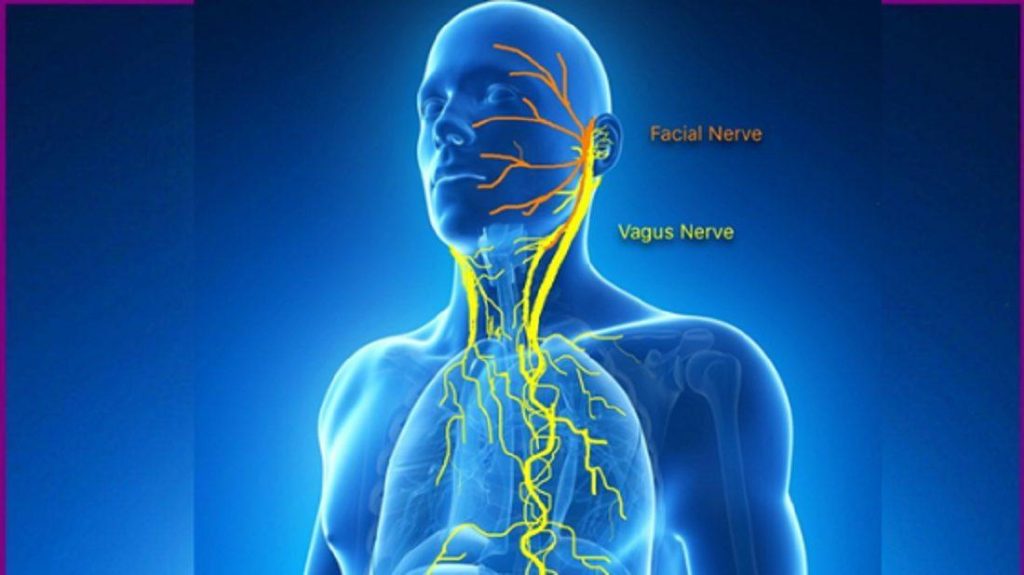
The vagus nerve isn’t just any nerve -it’s the longest and most complex cranial nerve in your body, a superhighway of information extending from your brainstem to nearly every major organ. While we often think of nerves as simply carrying commands from brain to body (“move your hand,” “blink your eyes”), the vagus nerve operates more like a sophisticated two-way surveillance and response system.
Rather than the internet (which suggests equal upload and download speeds), think of the vagus nerve as a massive intelligence network with thousands of field agents (receptors throughout your body) constantly sending reports back to headquarters (your brain).
A staggering 80% of its fibers are afferent, meaning they carry information from your body to your brain, not the other way around (Porges, 2011; Visser et al., 1997).
This flips our understanding of perception on its head.
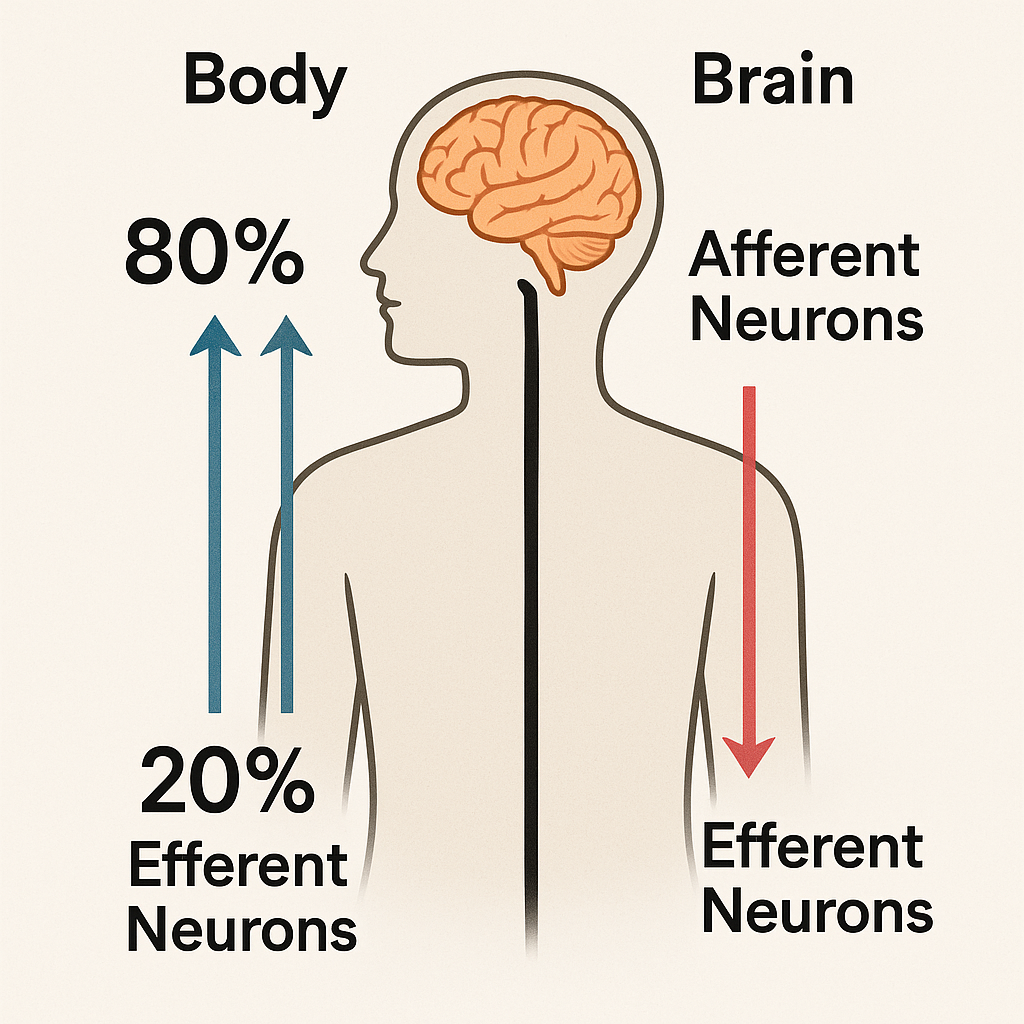
It means: Your gut feelings aren’t metaphors – they’re literal neural messages being transmitted through this remarkable nerve. When we say we feel “butterflies in our stomach” from anxiety or that something “doesn’t feel right,” that’s your vagus nerve delivering real-time intelligence about your internal state to your brain.
In other words:
Understanding doesn’t just happen in the head—it has to ‘sink in’ through the body. This isn’t poetic language; it’s biological reality. Your body is constantly “voting” on whether a situation feels safe or dangerous, and that vote reaches your brain through the vagus pathway before conscious thought even begins.
This revelation changes everything about how we approach learning and communication. When we try to reason with a student – or anyone – we can’t just tell them what to think or feel. They must feel it for themselves. Emotional resonance and safety must be experienced in the body before cognitive understanding can take root.
This is why phrases like “it has to sink in” are more than expression – they reflect the deep wisdom of our biology. The body must first signal safety before the brain can fully engage in higher-order thinking, creativity, and connection.
Understanding this hierarchy allows us to recognize where we are and, more importantly, find our way back up to connection.
Practical Tools for Nervous System Resilience
Since our automatic stories follow our autonomic states, the key to nervous system resilience is learning how to shift into ventral vagal.
Here are three core practices to regulate your nervous system:
1. The Essential “Notice & Name” Skill
- Notice where you are on your nervous system ladder.
- Name the state (Ventral, Sympathetic, or Dorsal).
- Turn toward your experience with curiosity, not judgment.
- Listen for a moment—what story is your nervous system telling?
2. The Three Stories Practice
- Recall a moment of mild irritation.
- View it through the lens of sympathetic (fight/flight)—what’s the story?
- View it through dorsal shutdown—how does the story change?
- View it through ventral connection—what shifts?
3. Finding Your Ventral Vagal Anchors
Identify your personal sources of regulation:
- Who helps you feel safe and connected?
- What activities reliably bring you a sense of ease?
- Where do you feel most regulated?
- When do you naturally find ventral vagal moments?
You Can’t Reset in Survival Mode
One of the most important insights from Polyvagal Theory is that reset and regulation are impossible when someone is stuck in survival mode. When the nervous system detects threat, it shifts into sympathetic (fight/flight) or dorsal vagal (freeze/shutdown) states. In these states, executive function, empathy, and learning shut down.
To truly “reset” or co-regulate, one must first exit survival mode and re-enter ventral vagal state, where safety, connection, and curiosity are possible. This is why trying to reason with someone who is triggered or shut down rarely works – their biology physically prevents the kind of receptivity needed for logical processing.
Final Thoughts: Building a Resilient Nervous System
Your nervous system already knows how to navigate these states. Resilience isn’t about staying in ventral vagal all the time – it’s about knowing how to find your way back.
As Thich Nhat Hanh reminds us:
“Earth will be safe when we feel in us enough safety.”
By cultivating nervous system awareness – both in ourselves and others- we create a foundation for co-regulation, connection, and change.
So, what’s one small shift you can make today to anchor yourself in safety and connection?
Remember, the path to understanding doesn’t start in the mind—it begins in the body.
Transition: From Understanding to Integration
Understanding Polyvagal Theory gives us a powerful lens for recognizing how safety, connection, and regulation shape every interaction. But insight alone isn’t enough. We need a reliable way to bring these concepts into our daily lives—to translate theory into practice, and biology into behavior.
That’s where the RESET model comes in.
RESET is a practical framework designed to help us recognize our state, regulate our nervous system, and return to connection—moment by moment, breath by breath. It allows us to pause, shift, and restore safety in ourselves and those around us.
Through real-world examples of the RESET model in action, we’ll explore how to embed nervous system literacy into everyday experiences—whether in a classroom, a courtroom, a family, or a friendship.
And as we begin to understand how to use RESET to shift our state, we’ll eventually turn toward a deeper practice: embodied learning—a way of knowing and integrating that moves beyond the mind and into the body itself.
Because once the body feels safe, learning doesn’t just happen. It lives.
Introducing the RESET Model
A Human Approach to Nervous System Resilience through Polyvagal Wisdom
Polyvagal Theory, developed by Dr. Stephen Porges, offers us a powerful lens to understand how our bodies and nervous systems respond to stress, connection, and safety. But let’s be honest – while the science is profound, it can also feel clinical or overwhelming. That’s why I created the RESET model – a simple, human-centered framework to integrate this life-changing theory into the everyday forms that matter most: parenting, partnering, leading, and learning.
RESET stands for:
R – Regulate
E – Embody
S – Settle
E – Engage
T – Transform
RESET isn’t just a strategy – it’s a rhythm.
It’s a way of coming back to yourself before reaching out to others.
Because unless we’re regulated, we can’t lead. We can’t connect. We can’t teach. We can’t love.
This model honors the truth that our reactions are often reflexive, shaped by our nervous system’s subconscious detection of safety or danger – what Polyvagal Theory calls neuroception. RESET helps us shift from survival to presence, from protection to connection.
Here’s the key:
You can’t RESET if you’re still in survival mode.
The first act is always Regulation.
From there, we embody awareness, settle the system, engage with presence, and create space for transformation – not just in others, but within ourselves.
Whether you’re facing a child’s meltdown, a partner’s withdrawal, a team’s resistance, or a student’s shutdown – RESET invites you to pause, return, and relate from a place of grounded safety.
This is how we bring the theory to life.
This is how we turn science into compassion.
This is how we become safe people who create safe spaces.
Learning Example
Stress Signs: Freezing on tests, acting out.
Step / Action
R – Regulate: Begin class with a simple breath or stretch exercise.
E – Embody: Model relaxation by using a calm tone and open posture.
S – Settle: Allow time for students to feel into their bodies before diving into tasks.
E – Engage: Offer simple co-regulation prompts (“Notice your breathing…you’re safe”).
T – Transform: Help students build their own self-regulation tools for future challenges.
Leading Example
Stress Signs: Micromanaging, disconnection.
Step / Action
R – Regulate: Take a pause before giving feedback; breathe and check your tone.
E – Embody: Model grounded leadership by softening posture and facial expression.
S – Settle: Name your own emotions and settle before addressing team issues.
E – Engage: Use reflective listening and validate others’ perspectives.
T – Transform: Foster psychological safety and model adaptive regulation for the group.
Parenting Example
Stress Signs: Yelling, rigid rules.
Step / Action
R – Regulate: Pause and take 3 slow breaths to downshift your own nervous system.
E – Embody: Feel your feet on the floor; notice where you hold tension and soften it.
S – Settle: Sit or kneel at the child’s level to create physical and emotional safety.
E – Engage: Use a calm voice, soft eyes, and validating words (“I see you’re upset”).
T – Transform: Only after co-regulation, help the child name feelings and problem-solve.
Partnering Example
Stress Signs: Reactivity, blaming.
Step / Action
R – Regulate: Notice the urge to argue; breathe deeply and loosen your jaw/shoulders.
E – Embody: Tune into your body sensations instead of the story in your head.
S – Settle: Create physical space if needed, or touch your heart or chest gently.
E – Engage: Speak from vulnerability (“I feel overwhelmed, not angry”).
T – Transform: Shift from conflict to connection by repairing (“I want us to feel close again”).
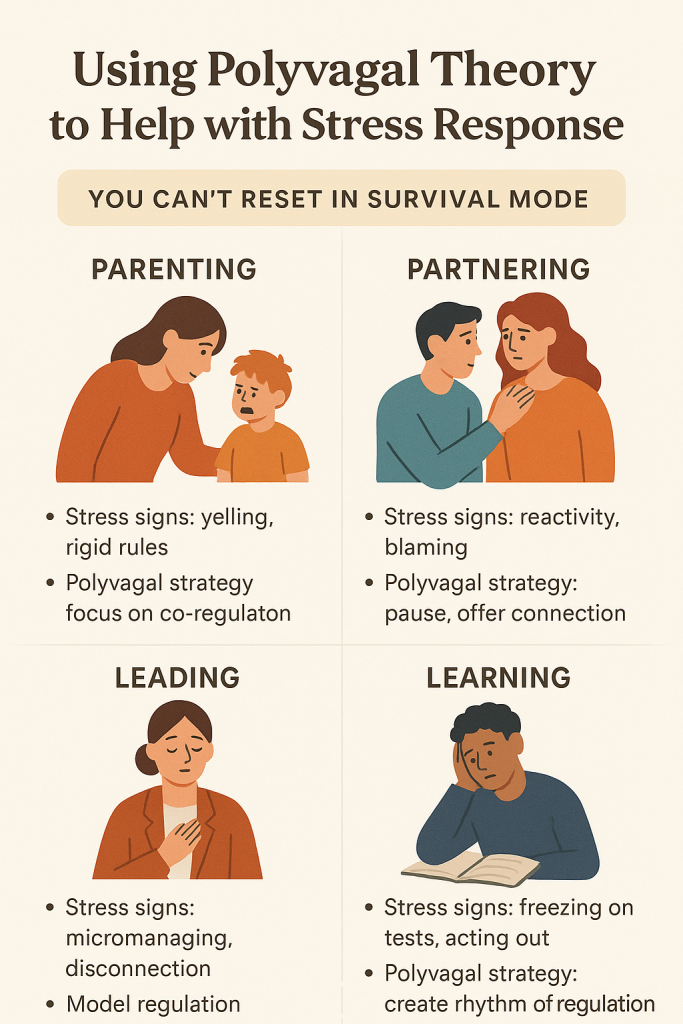
Now let’s anchor it in the real world of emotionally charged situation – whether interpersonal, emotional, or societal – we make it more than a framework: it becomes a daily nervous system ritual.
Here’s a set of examples that include conflict, emotion-based, and broad, difficult societal contexts – each followed by how RESET can be applied:
Conflict: Dealing with a Difficult Colleague
Scenario: You feel dismissed in a meeting, your ideas shut down with sarcasm.
RESET in Action:
R – Regulate: Step away briefly, breathe deeply, or place your hand over your heart.
E – Embody: Notice your body’s cues—tight jaw, clenched fists—and intentionally soften.
S – Settle: Give your system a moment to downshift before reacting.
E – Engage: Approach the colleague later, with steady tone and curiosity instead of accusation.
T – Transform: Create a boundary or name the impact without shame, allowing space for relational repair.
Emotion: Feeling Overwhelmed by Anxiety
Scenario: You’re spiraling with racing thoughts and tightness in your chest before a big presentation.
RESET in Action:
R – Regulate: Use breathwork (box breathing or 4-7-8) to signal safety to your body.
E – Embody: Ground through your senses—feet on the floor, holding something textured.
S – Settle: Reassure your system: “This is discomfort, not danger.”
E – Engage: Speak gently to yourself—“I’m allowed to be nervous and still show up.”
T – Transform: Step forward with courage, noticing how self-regulation shifts your energy.
Societal: Watching the News and Feeling Hopeless
Scenario: The weight of war, climate crisis, or injustice triggers helplessness or despair.
RESET in Action:
R – Regulate: Step away from the screen. Let your exhale be longer than your inhale.
E – Embody: Return to your body. Touch something living—a plant, a pet, yourself.
S – Settle: Sit somewhere quiet. Remind your body that safety exists here and now.
E – Engage: Reach out to someone. Write a thought. Make a small act of care.
T – Transform: Commit to one micro-action that aligns with your values, rather than staying frozen in fear.
Emotion: Navigating Frustration When Things Don’t Go as Planned
Scenario: You’re running late, nothing’s working, and your patience is wearing thin.
RESET in Action:
R – Regulate: Name it—“I’m frustrated.” Breathe into your belly.
E – Embody: Feel your shoulders; are they by your ears? Drop them. Shake out tension.
S – Settle: Accept what is, rather than fighting reality.
E – Engage: Respond, not react—speak to others (and yourself) with less charge.
T – Transform: End the loop of reactivity. Ask: “What’s the next kind thing I can do?”
Conflict: Feeling Misunderstood in a Close Relationship
Scenario: You’ve said something important, and the other person reacts with defensiveness.
RESET in Action:
R – Regulate: Pause and take a breath instead of escalating.
E – Embody: Feel your body’s urge to defend or explain—can you soften?
S – Settle: Say, “I want to understand. Can we slow down?”
E – Engage: Shift from winning to connecting—ask a curious question.
T – Transform: Co-create a new way forward by naming both your needs and theirs.
Emotion: Shame Spiral After Making a Mistake
Scenario: You made a public error and feel exposed or humiliated.
RESET in Action:
R – Regulate: Breathe with your hand on your chest—offer warmth to yourself.
E – Embody: Notice if you’re collapsing inward—lift your posture gently.
S – Settle: Say to yourself, “I made a mistake. I’m still worthy.”
E – Engage: Reach out to someone safe and share your experience without editing.
T – Transform: Use the experience to learn, not to punish yourself.
Through movement, breath, mindfulness, and shared presence, we will now learn how to RESET not just in theory – but in the body.
Because the Body Remembers
And perhaps this is the heart of it:
As Maya Angelou once said, “People will forget what you said, people will forget what you did, but people will never forget how you made them feel.”
In classrooms, this isn’t just a sentiment—it’s a neurobiological truth.
Before a child can think, they must feel.
Descartes declared, “I think, therefore I am,” but the nervous system reminds us: I feel, therefore I can think.
Learning is not simply a cognitive transaction – it’s a full-body experience.
Safety, connection, co-regulation – these aren’t extras; they are the foundation. And every time we meet a child with presence instead of pressure, with attunement instead of urgency, we invite their nervous systems to settle, to open, to trust.
Because what lasts is not just what they learn, but how their bodies remember.