Una de las herramientas más poderosas que tenemos para comprender nuestra vida emocional es entender cómo funciona nuestro sistema nervioso—especialmente en el contexto del trauma.
Recientemente me encontré con un breve video animado creado por el Polyvagal Institute, titulado “Trauma and the Nervous System: A Polyvagal Perspective”. En solo unos minutos, este video ofrece una explicación bellamente clara de cómo el trauma no es solo una historia del pasado, sino un estado fisiológico que vive en el cuerpo.
El video introduce ideas clave como la movilización (lucha/huida), la inmovilización (congelamiento), la neurocepción, la regulación, y también toca temas como la epigenética del trauma y las Experiencias Adversas en la Infancia (ACEs).
Estas son ideas fundamentales—pero pueden ser nuevas para muchas personas.
Por eso he creado una serie de preguntas de comprensión para acompañar el video. No están pensadas como un examen, sino como una invitación a pausar, reflexionar y profundizar en el contenido. Estas preguntas pueden ayudar a aclarar términos nuevos, promover la autoconciencia y generar conversaciones significativas.
Si eres educador(a), estas preguntas también pueden ser un recurso valioso en tu aula o espacio de formación. He descubierto que funcionan especialmente bien cuando se abordan en parejas o grupos pequeños, o incluso como actividades de escritura reflexiva. Abren la puerta a una comprensión más profunda—no solo del sistema nervioso, sino también de nosotros mismos y de los demás.
✨ Preguntas de comprensión
¿Qué significa estar “movilizado” en tu sistema nervioso?
En el video, ¿qué comportamientos o sensaciones físicas muestran que alguien está en un estado de lucha o huida (movilizado)?
¿Qué significa “regulación”—y por qué es importante?
¿Cómo ayuda la regulación a que el sistema nervioso regrese a un estado de calma y seguridad?
¿Cómo se define el “trauma” en este video?
¿Cómo va esta definición más allá de simplemente un “evento negativo”? ¿Qué hace que algo sea traumático para el sistema nervioso?
¿Qué es la “neurocepción”—y en qué se diferencia de la percepción?
¿Qué papel juega este proceso inconsciente para ayudarnos a sentirnos seguros, en peligro, o desconectados?
¿Cuáles son los tres estados del sistema nervioso explicados en el video?
¿Puedes describir cómo podría comportarse o sentirse alguien en cada estado: compromiso social, lucha/huida y desconexión/inmovilización?
¿Qué son las Experiencias Adversas en la Infancia (ACEs) y cómo impactan el sistema nervioso?
¿Por qué son importantes las ACEs cuando hablamos de trauma y salud a largo plazo?
¿Cuál es la conexión epigenética con el trauma?
¿Cómo puede transmitirse el trauma de generación en generación—no solo a través de relatos o comportamientos, sino también biológicamente?
¿Qué sucede cuando luchar o huir no funciona?
Cuando alguien no puede escapar ni defenderse, ¿qué respuesta de supervivencia podría activarse—y cómo se siente o se ve eso?
¿Por qué es importante comprender estos estados del sistema nervioso cuando apoyamos a alguien que ha experimentado trauma?
¿Cómo podría esta comprensión cambiar la forma en que respondemos a los demás—o a nosotros mismos?
¿Qué nos ayuda a regresar a un estado “regulado”?
¿Puedes nombrar una cosa—del video o de tu propia experiencia—que ayude a calmar o anclar tu sistema nervioso?
Comprender cómo nuestros cuerpos responden al peligro y a la seguridad no es solo una idea científica—es un camino hacia la compasión, la sanación y la conexión. Ya seas docente, terapeuta, madre/padre, o simplemente una persona que busca entenderse mejor, espero que este video—y estas preguntas—te ofrezcan algo significativo.
One of the most powerful tools we have for making sense of our emotional lives is understanding how our nervous system works—especially in the context of trauma.
I recently came across a short animated video created by the Polyvagal Institute titled “Trauma and the Nervous System: A Polyvagal Perspective.” In just a few minutes, this video offers a beautifully clear explanation of how trauma is not just a story from the past, but a physiological state that lives in the body.
It introduces key ideas like mobilization (fight/flight), immobilization (freeze), neuroception, regulation, and even touches on the epigenetics of trauma and Adverse Childhood Experiences (ACEs).
These are essential ideas—but they may be new to many people.
That’s why I’ve created a set of comprehension questions to go along with the video. They’re designed not as a test, but as an invitation to slow down, reflect, and engage more deeply with the material. They can help clarify some of the new terminology, prompt self-awareness, and spark meaningful discussion.
If you’re an educator, these questions can also be a valuable resource in your classroom or training space. I’ve found that they work especially well when offered in pairs or small groups, or even as journaling prompts. They open the door to deeper understanding—not only of the nervous system but of ourselves and others.
What does it mean to be “mobilized” in your nervous system? In the video, what behaviors or physical sensations show that someone is in a mobilized (fight or flight) state?
What does “regulation” mean—and why does it matter? How does regulation help the nervous system shift back into a safe, calm state?
How is “trauma” defined in this video? How does this definition go beyond just a “bad event”? What makes something traumatic to the nervous system?
What is “neuroception”—and how is it different from perception? What role does this unconscious process play in helping us feel safe, in danger, or shut down?
What are the three states of the nervous system explained in the video? Can you describe how someone might behave or feel in each state: social engagement, fight/flight, and shutdown?
What are Adverse Childhood Experiences (ACEs), and how do they impact the nervous system? Why do ACEs matter when we talk about trauma and long-term health?
What is the “epigenetic” connection to trauma? How can trauma be passed down through generations—not just through stories or behavior, but biologically?
What happens when fight or flight doesn’t work? When someone can’t escape or defend themselves, what survival response might take over—and what does that feel or look like?
Why is it important to understand these nervous system states when supporting someone who’s experienced trauma? How might this understanding change how we respond to others—or ourselves?
What helps us return to a “regulated” state? Can you name one thing—either from the video or your own experience—that helps calm or anchor your nervous system?
Understanding how our bodies respond to threat and safety isn’t just a scientific idea—it’s a pathway toward compassion, healing, and connection. Whether you’re a teacher, therapist, parent, or someone simply trying to understand yourself better, I hope this video—and these questions—offer something meaningful.
What if the most powerful teaching tool we possess isn’t our curriculum, training, or strategies—but our nervous system?
In every classroom, behind every lesson, every moment of connection or rupture, there is a biology at work—an ancient, intelligent system that determines whether we can show up, speak up, settle down, or tune in. That system is the autonomic nervous system, and at its core is the vagus nerve, the master communicator of our internal state.
When we feel safe, connected, and calm, the vagus nerve helps us access creativity, empathy, and flexibility—qualities that are essential not just for students, but for the educators who guide them. But when we’re under threat—real or perceived—our nervous system shifts into survival mode. We lose access to higher thinking, compassion, and relational depth.
This doesn’t mean something’s wrong with us. It means something intelligent is happening within us.
Understanding this is the foundation of nervous system resiliency—the capacity to recognize, regulate, and return to safety.
And for educators, this understanding changes everything.
The Vagus Nerve: The Biological Bridge to Safety
The vagus nerve actively monitors and responds to cues of safety or danger in our environment—through tone of voice, facial expression, body language, and rhythm. This process, called neuroception, happens beneath conscious awareness.
When we speak kindly, offer eye contact, move slowly, or hold space with warmth, we send powerful vagal cues that say: You’re safe here. The result? Students feel more open to learning, more connected to others, and more at ease in their own bodies.
But the reverse is also true. When our classrooms are governed by speed, pressure, or emotional disconnection, students—especially those with trauma histories—may feel unsafe. Their bodies react, even if their minds can’t name why.
Understanding the nervous system’s language—and learning how to speak it—is a radical act of care and an essential part of trauma-informed teaching.
Why Nervous System Literacy Matters
Nervous system literacy isn’t just neuroscience—it’s pedagogy. It’s the embodied knowledge that we are teaching human beings with beating hearts, shifting moods, and deep biological needs.
It helps us answer questions like:
• Why can’t this student focus today?
• Why do I feel so reactive right now?
• How can we restore connection after rupture?
• What does safety feel like in a classroom?
It offers an invitation: teach not to the body, but with the body.
This is where the Five Principles of Embodied Learning offer a transformative lens.
Integrating Nervous System Literacy through the Five Principles of Embodied Learning
These five principles, developed by Ross Anderson, offer a practical, compassionate framework for connecting nervous system awareness to teaching and learning.
Let’s explore how they support regulation, connection, and meaning-making:
✅ 1. Introduce Movement
Why it works: Movement helps shift students out of freeze or fight-or-flight and back into a regulated state. It brings abstract ideas into the body, where they can be felt and understood.
Nervous system connection: Movement activates the vagus nerve through joint movement, rhythm, and breath. It signals safety and presence.
Example: Use role-play or tableau to embody historical events. Let students physically “step into” ideas or emotions they’re studying.
✅ 2. Normalize Emotional Awareness
Why it works: When students learn to name and notice their emotions, they begin to develop interoception—the ability to feel and interpret their internal states.
Nervous system connection: Naming emotions helps calm the amygdala and engage the prefrontal cortex. It supports regulation and builds vagal tone.
Example: Begin lessons with “How are you feeling in your body today?” or use emotion wheels and body maps to track states during challenging tasks.
✅ 3. Encourage Metaphors
Why it works: Metaphors link learning to personal, sensory experience. They create a bridge between left-brain logic and right-brain felt sense.
Nervous system connection: Metaphors engage imagination and relational memory, activating parts of the brain that support meaning and emotional integration.
Example: Ask students to describe a concept as a weather system, a color, or a kind of music. “If this poem were a heartbeat, how fast would it go?”
✅ 4. Build Social Safety
Why it works: Learning requires vulnerability. Students need to feel safe to take risks, make mistakes, and express themselves.
Nervous system connection: Social safety is regulated through the ventral vagus. When students sense welcome, attunement, and boundaries, their systems relax into connection.
Example: Use circle check-ins, community agreements, and collaborative work that emphasizes mutual support over competition.
✅ 5. Integrate Reflection
Why it works: Reflection allows students to track their own learning process—and their emotional and physical experience of it. It fosters self-awareness and metacognition.
Nervous system connection: Reflection activates the default mode network and supports vagal regulation. It allows meaning to emerge from embodied experience.
Example: Use journaling prompts like “What did your body notice today?” or “When did you feel most connected or distant during the lesson?”
The Future of Teaching Is Embodied
These practices are not extras. They are the soil in which meaningful learning grows.
As educators, we are nervous system co-regulators. Every gesture, tone, pause, and breath sends a message: You’re safe. You matter. You belong.
And that message isn’t just comforting—it’s transformative.
When we integrate nervous system awareness with pedagogy, we don’t just reduce stress or increase engagement. We help students remember what it feels like to be whole.
Introducing the Workshop: Teaching from Safety
If you’re ready to deepen this work in community, I invite you to join me for a six-part workshop called:
Teaching from Safety: Nervous System Resiliency for Educators
This workshop is designed to:
• Help you regulate your own nervous system
• Support student co-regulation and connection
• Integrate embodied practices into your teaching
🧠 The Six Modules:
1. Mapping the Nervous System
Understand sympathetic, parasympathetic, freeze, and the power of the vagus nerve.
2. Cues of Safety and Neuroception
Learn how to recognize and offer the subtle signals that restore connection.
3. Regulation Practices and Vagal Tone
Explore breathwork, rhythm, voice, and simple movement tools.
4. Co-Regulation in Real Time
Practice repairing ruptures and creating responsive, resilient classrooms.
5. Embodied Pedagogy and Student Resiliency
Apply the five principles of embodied learning to lesson design.
6. Sustainability and Nervous System Care Planning
Create your own “resiliency toolkit” to support teaching from safety long-term.
If you’re feeling the call to teach from a place of presence—not pressure—and to help your students do the same, this workshop is for you.
Let’s reimagine education not just as instruction, but as co-regulation, restoration, and transformation.
Because when we teach from safety, we change lives—starting with our own.
A Nervous System-Informed Approach to Transformation
This coaching process unfolds in three stages, grounded in Polyvagal Theory, Interpersonal Neurobiology, and the science of intentional, self-directed neuroplasticity.
STAGE ONE: Understand Your Nervous System
Reconnect with your body’s innate intelligence.
Learn how your autonomic nervous system works — why you go into fight, flight, freeze, or fawn — and how to recognize the signs of each state in real time.
We explore:
• Polyvagal Theory: the biology of safety and connection
• Neuroception: how your body scans for threat without your permission
• Your personal nervous system map — what regulation and dysregulation look like for you
• The vagus nerve and why self-regulation starts with the body
“To feel abandoned is to deny the intimacy of your surroundings.” — David Whyte
This stage is about noticing what’s already supporting you, before you try to fix or change anything.
STAGE TWO: Identify the Transformation You Seek
Clarify the change you want, in a way your body can believe.
This isn’t about setting abstract goals — it’s about naming the transformation your life is asking for through your body, your relationships, and your story.
Not just “be a better dad,” but show up at drop-off without dissociating.
Not just “find purpose,” but stop abandoning yourself at work.
We recognise that …
“Transformation begins with truth — and your nervous system has to feel that it’s possible.”
STAGE THREE: Apply the RESET Model
Neural Exercises for Lasting Change
Change is not intellectual. It’s physiological. In this stage, you’ll practice neural exercises from the RESET Model, a five-part rhythm that helps you build new patterns in your body and brain.
The RESET Model:
• R – Regulate through breath, sound, and movement
• E – Embody your lived experience without judgment
• S – Settle the body and grow stillness capacity
• E – Engage from safety and co-regulation
• T – Transform through repetition, intention, and somatic memory
These tools leverage your body’s natural ability to rewire itself, using focused attention and safety-based repetition.
The Outcome
You become more you — not the conditioned, performative version, but the present, embodied, resilient man who was never lost, just hidden.
You’ll learn how to:
• Pause instead of react
• Regulate instead of retreat
• Connect instead of collapse
• Parent, partner, and play from rooted presence
How It Works
We begin with a three-part arc. Each stage may take one or more sessions:
• Sessions 1–2: Understanding the nervous system
• Sessions 2–3: Identifying the transformation
• Sessions 4–6: Applying the RESET Model
Ongoing coaching is available for deeper integration.
Cómo la Seguridad Da Forma al Aprendizaje a Través del Sistema Nervioso
Entendiendo la Teoría Polivagal, la Co-Regulación y el Modelo RESET para
la Enseñanza y el Liderazgo con Información Autonómica
¿Alguna vez te has preguntado por qué cierta información resuena profundamente mientras que otras lecciones parecen desvanecerse? ¿Por qué ciertos maestros dejan una marca indeleble mientras que otros, a pesar de su experiencia, no logran conectar?
La respuesta podría estar no en la pedagogía, sino en la biología.
Quiero comenzar con una historia—es una historia sobre supervivencia, conexión y cómo nuestros cuerpos recuerdan la seguridad… o la falta de ella.
Los Bebés Que Dejaron de Respirar
En la década de 1980, un investigador llamado Stephen Porges trabajaba con bebés prematuros en unidades de cuidados intensivos neonatales. Estos eran bebés que, en papel, estaban médicamente estables. Estaban respirando. Sus signos vitales parecían bien.
Y luego—de repente—dejaban de respirar.
Sus frecuencias cardíacas se desplomaban.
Y morían.
Los médicos lo llamaban “fallo para prosperar”. Algunos lo asociaban con el Síndrome de Muerte Súbita del Lactante. Pero nadie sabía realmente por qué estos pequeños y vulnerables humanos se estaban apagando.
Porges comenzó a preguntarse: ¿Y si esto no se trataba de una enfermedad? ¿Y si se trataba del propio sistema nervioso, reaccionando al estrés abrumador de una manera que aún no entendíamos?
Comenzó a estudiar la variabilidad de la frecuencia cardíaca, que nos dice algo sobre cuán flexible y adaptativo es el sistema nervioso autónomo.
Lo que encontró fue que los bebés que prosperaban tenían algo muy específico en común: alto tono vagal – un sistema nervioso parasimpático fuerte y flexible, capaz de calmar el cuerpo y recuperarse del estrés.
¿Los que no estaban bien?
Tenían bajo tono vagal. Sus sistemas no podían recuperarse. Bajo estrés, no luchaban. No lloraban. No se movilizaban.
Se apagaban.
Esta comprensión llevó al Dr. Stephen Porges a proponer lo que ahora llamamos la Teoría Polivagal – un modelo que explica cómo el sistema nervioso autónomo ha evolucionado en capas:
El sistema vagal dorsal – la parte más antigua – responde a amenazas abrumadoras apagándose: colapso, disociación, inmovilización.
El sistema simpático – nos moviliza para luchar o huir.
Y el más reciente, el sistema vagal ventral – único en los mamíferos—nos permite conectar, co-regular, expresar emociones, hacer contacto visual y sentirnos seguros en las relaciones.
La Paradoja de Porges: Cuando la Conexión Se Vuelve Imposible
Aquí es donde entra la paradoja – y esta es la Paradoja de Porges:
El mismo sistema que nos permite conectar, sentirnos seguros y estar presentes con otros es el primero en desconectarse cuando nos sentimos amenazados.
En otras palabras: cuando alguien más necesita conexión, apoyo y seguridad—su biología puede impedirle acceder a ello. Su cuerpo no está “comportándose mal”. Está haciendo exactamente lo que fue diseñado para hacer para sobrevivir.
Y así, como educadores, terapeutas – de hecho, cualquiera que trabaje con seres humanos – esta teoría ofrece un cambio radical de perspectiva:
El comportamiento es biología.
La regulación precede al aprendizaje.
La seguridad no es un concepto – es un estado sentido.
El Cambio Fundamental: Reflejo Antes que Razón
De esta historia surge una invitación – una invitación a explorar no solo lo que hace la gente – sino en qué estado podría estar su sistema nervioso cuando lo hace.
Porque desde esa perspectiva, todo cambia.
Y aquí está la conclusión clave:
Todo comportamiento es fundamentalmente reflexivo, no intencional.
Cada interacción es un sistema nervioso que se encuentra con otro sistema nervioso – impulsado primero por reflejos, no por intención consciente. Cada vez que nos encontramos, no son mentes sino sistemas nerviosos los que se saludan.
El reflejo viene antes que la razón. El instinto antes que la intención.
Esto cambia todo.
No te encuentran con palabras, títulos o intenciones. Te encuentran con tono. Ritmo. Postura. Respiración.
Lo Que Esto Significa en la Práctica:
Educadores: No enseñas a un cerebro. Regulas un sistema. Un maestro desregulado no puede regular a un niño desregulado. La seguridad no es una estrategia – es el plan de estudios.
Médicos: Tu presencia sana antes que tu prescripción. Si el sistema nervioso no se siente seguro, ninguna verdad aterriza, ninguna confianza se construye.
Políticos: Las políticas son lógica. Pero la gente vota desde el instinto. Habla a la seguridad antes que a la estrategia – o nadie escucha.
Abogados: El argumento vive en la razón. Pero un cliente, un jurado, un juez – te sienten primero. No ganas mentes hasta que calmas cuerpos.
Padres: Tus hijos reflejan tu estado, no tus instrucciones. La calma es contagiosa. También lo es el caos.
Parejas: El amor no se escucha a través de palabras. Se siente a través de la presencia. Regúlate a ti mismo, o co-crearás desconexión.
Humanos: No importa tu rol – líder, amigo, extraño – eres un sistema nervioso en movimiento. O bien traes seguridad o no la traes.
La Pregunta Esencial para Educadores
No es, “¿Qué quise decir?”
Es siempre, “¿Qué sintió su cuerpo de mí?”
Reflejo antes que razón. Instinto antes que intención. Regular antes de relacionarse.
El Cambio del Educador: Del Contenido a la Conexión
Si cambiamos la pregunta guía del educador de “¿Qué quise decir?” a “¿Qué sintió su cuerpo de mí?”, dejamos de preguntar qué entendieron los estudiantes y comenzamos a preguntar qué absorbieron – no con su intelecto, sino con sus sistemas nerviosos.
Aquí hay 10 ejemplos poderosos de ese cambio – sentido, no memorizado:
¿Mi presencia se sintió segura o apresurada? No: ¿Logré terminar la lección?
¿Mi tono invitó a la curiosidad o desencadenó defensa? No: ¿Prestaron atención?
¿Me sentí con los pies en la tierra, o filtré mi estrés en la sala? No: ¿Estuve organizado?
¿Mis ojos dijeron, “Te veo”, o “Apúrate”? No: ¿Llamé a todos?
¿Mi ritmo y respiración calmaron o los aceleraron? No: ¿Completaron la tarea?
¿Mi silencio se sintió espacioso o amenazante? No: ¿Les di suficiente tiempo de espera?
¿Me moví con autoridad tranquila o urgencia ansiosa? No: ¿Fue efectiva mi gestión del aula?
¿Mi energía señaló “perteneces aquí” o “gánate tu lugar”? No: ¿Dije las palabras correctas?
¿Traje calidez, o me protegí con neutralidad? No: ¿Fui profesional?
¿Me regulé a mí mismo para que pudieran co-regular conmigo? No: ¿Se comportaron?
Porque mucho después de que el contenido se desvanece, el cuerpo recuerda:
Cómo se sintió estar en tu presencia.
Ese es el verdadero plan de estudios.
Entendiendo el Sistema Nervioso a Través de la Teoría Polivagal
Tu sistema nervioso está constantemente trabajando entre bastidores, dando forma a cómo experimentas el mundo. Determina si te sientes lo suficientemente seguro para conectar, comprometerte y prosperar – o si necesitas protegerte apagándote o volviéndote reactivo.
En el núcleo de la Teoría Polivagal hay tres principios organizadores:
Co-Regulación – El imperativo biológico para la conexión. Neurocepción – La detección subconsciente de seguridad o peligro. Jerarquía – Los tres estados predecibles del sistema nervioso:
Vagal Ventral: Seguridad y conexión.
Simpático: Lucha o huida.
Vagal Dorsal: Apagado y colapso.
Co-Regulación: El Fundamento de la Conexión
El sistema nervioso siempre está escaneando en busca de una respuesta a una pregunta clave: ¿Es seguro conectar?
Estamos programados para buscar conexión, pero cuando nuestro instinto de supervivencia anula ese impulso, nos retiramos o nos volvemos defensivos. El Dr. Stephen Porges describe el trauma como “una interrupción crónica de la conectividad”. El trauma, entonces, no se trata solo de un evento único – se trata de un sistema nervioso que ha aprendido a permanecer en modo de protección.
Nuestros sistemas nerviosos se forman a través de interacciones con otros. En cada momento, enviamos y recibimos señales – ya sea señalando seguridad y co-regulación o reforzando patrones de estrés y supervivencia.
Como dice Deb Dana: “Nuestra mayor responsabilidad—ya sea como padres, profesionales o simplemente como humanos—es cultivar un sistema nervioso regulado y servir como una presencia estable y fundamentada para otros”.
Neurocepción: Cómo Nuestro Sistema Nervioso Detecta Seguridad y Peligro
A diferencia de la percepción, que ocurre en nuestro cerebro pensante, la neurocepción es la forma subconsciente de nuestro sistema nervioso de detectar señales del entorno, nuestro cuerpo y nuestras relaciones.
Opera en tres dominios:
Dentro – Sensaciones desde dentro del cuerpo (por ejemplo, pecho apretado, respiración relajada).
Fuera – Señales ambientales (por ejemplo, un ruido fuerte, una sonrisa cálida).
Entre – Compromiso social (por ejemplo, el tono de una voz, una expresión facial).
Debido a que la neurocepción está moldeada por nuestras experiencias pasadas, no siempre es precisa. A veces, interpretamos mal situaciones seguras como peligrosas o no reconocemos amenazas reales. Por ejemplo, un estudiante podría estremecerse cuando un maestro levanta ligeramente la voz – no porque haya un peligro real, sino porque su cuerpo recuerda traumas pasados asociados con sonidos similares.
Jerarquía: Las Tres Vías de Respuesta
El sistema nervioso opera en una jerarquía predecible:
Vagal Ventral (Seguridad y Conexión)
Tranquilo, comprometido, conectado.
El estado donde ocurren la salud, el crecimiento y el aprendizaje.
Simpático (Movilización: Lucha o Huida)
Energía activada, urgencia, protección.
Puede sentirse como ansiedad, inquietud o agresión.
Vagal Dorsal (Apagado: Congelación y Colapso)
Entumecido, desconectado, baja energía.
Puede sentirse como agotamiento, disociación o depresión.
El Cuerpo Lidera, El Cerebro Sigue
Entender estos tres estados se vuelve aún más crucial cuando reconocemos una verdad fundamental sobre nuestra neurobiología—una centrada en una estructura increíble llamada el nervio vago.
¿Qué Es el Nervio Vago? El Centro de Control del Cuerpo
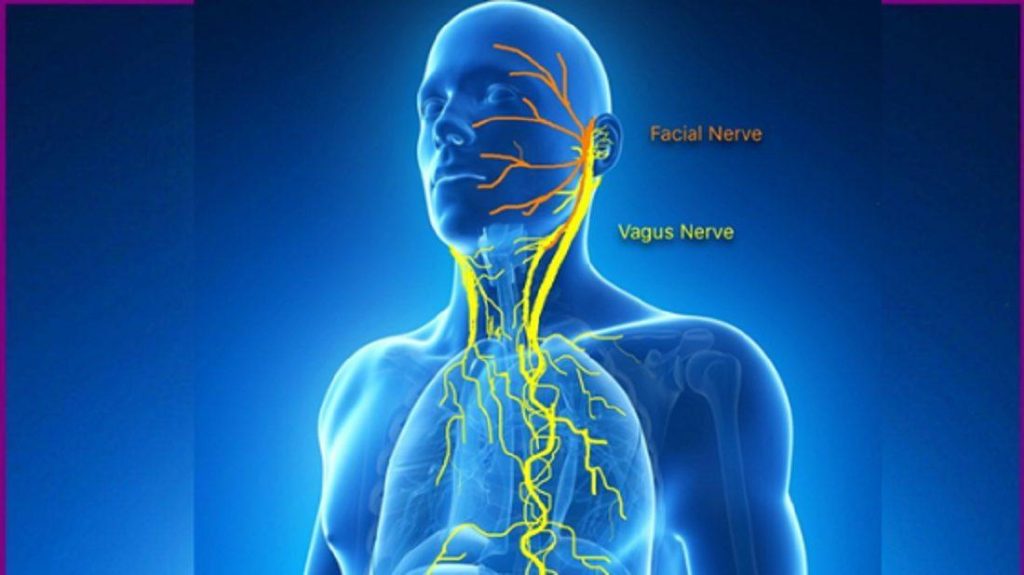
El nervio vago no es solo cualquier nervio – es el nervio craneal más largo y complejo en tu cuerpo, una supercarretera de información que se extiende desde tu tronco cerebral hasta casi todos los órganos principales. Mientras que a menudo pensamos en los nervios como simplemente llevando comandos del cerebro al cuerpo (“mueve tu mano”, “parpadea tus ojos”), el nervio vago opera más como un sofisticado sistema de vigilancia y respuesta bidireccional.
En lugar de internet (que sugiere velocidades de carga y descarga iguales), piensa en el nervio vago como una red masiva de inteligencia con miles de agentes de campo (receptores en todo tu cuerpo) constantemente enviando informes de vuelta al cuartel general (tu cerebro).
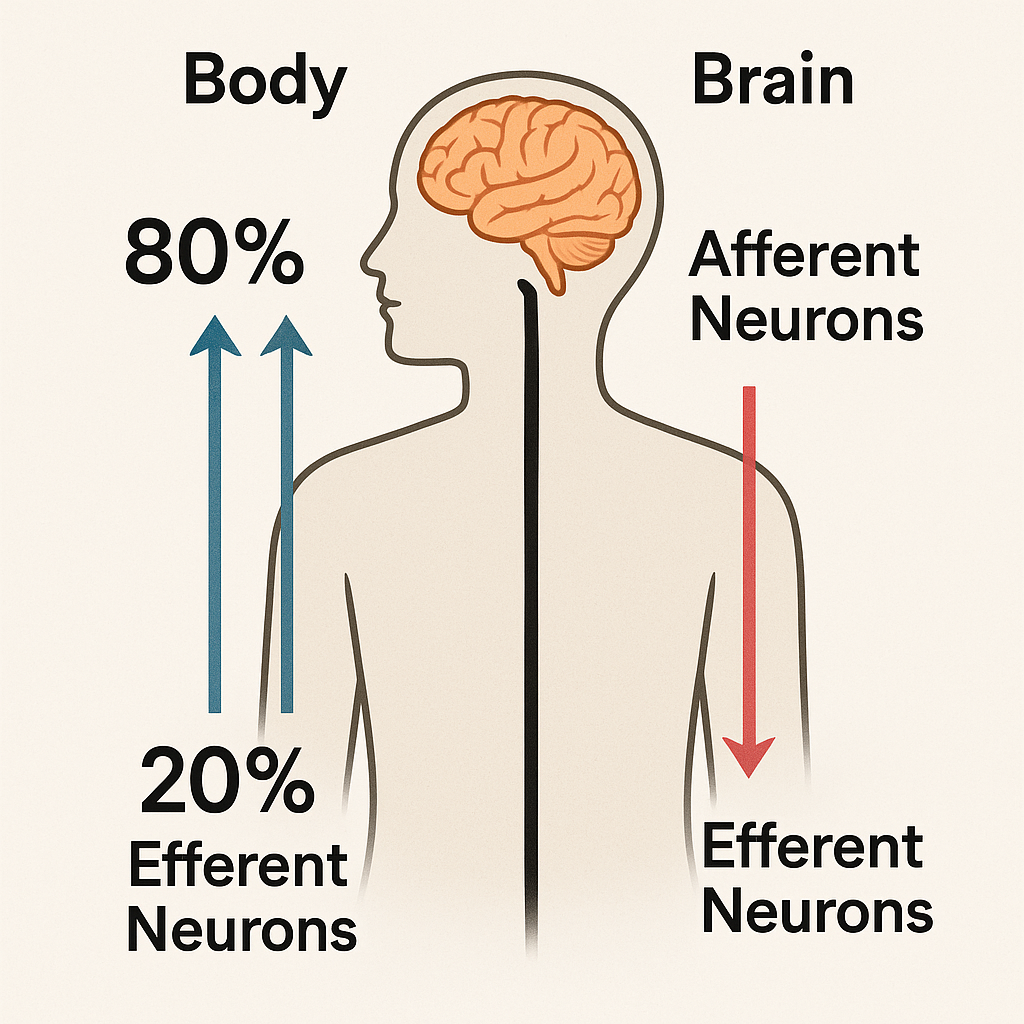
Un asombroso 80% de sus fibras son aferentes, lo que significa que llevan información de tu cuerpo a tu cerebro, no al revés (Porges, 2011; Visser et al., 1997).
Esto voltea nuestra comprensión de la percepción.
Significa: Tus sensaciones viscerales no son metáforas – son mensajes neurales literales que se transmiten a través de este notable nervio. Cuando decimos que sentimos “mariposas en el estómago” por ansiedad o que algo “no se siente bien”, ese es tu nervio vago entregando inteligencia en tiempo real sobre tu estado interno a tu cerebro.
En otras palabras:
La comprensión no solo ocurre en la cabeza—tiene que ‘penetrar’ a través del cuerpo. Esto no es lenguaje poético; es realidad biológica. Tu cuerpo está constantemente “votando” sobre si una situación se siente segura o peligrosa, y ese voto llega a tu cerebro a través de la vía vagal antes de que el pensamiento consciente siquiera comience.
Esta revelación cambia todo sobre cómo abordamos el aprendizaje y la comunicación. Cuando tratamos de razonar con un estudiante – o cualquier persona – no podemos simplemente decirles qué pensar o sentir. Deben sentirlo por sí mismos. La resonancia emocional y la seguridad deben ser experimentadas en el cuerpo antes de que la comprensión cognitiva pueda echar raíces.
Es por eso que frases como “tiene que calar hondo” son más que expresiones – reflejan la profunda sabiduría de nuestra biología. El cuerpo debe primero señalar seguridad antes de que el cerebro pueda comprometerse completamente en el pensamiento de orden superior, la creatividad y la conexión.
Entender esta jerarquía nos permite reconocer dónde estamos y, más importante aún, encontrar nuestro camino de regreso a la conexión.
Herramientas Prácticas para la Resiliencia del Sistema Nervioso
Dado que nuestras historias automáticas siguen nuestros estados autonómicos, la clave para la resiliencia del sistema nervioso es aprender cómo cambiar al estado vagal ventral.
Aquí hay tres prácticas fundamentales para regular tu sistema nervioso:
1. La Habilidad Esencial “Notar y Nombrar”
Nota dónde estás en tu escala del sistema nervioso.
Nombra el estado (Ventral, Simpático o Dorsal).
Vuélvete hacia tu experiencia con curiosidad, no con juicio.
Escucha por un momento—¿qué historia está contando tu sistema nervioso?
2. La Práctica de las Tres Historias
Recuerda un momento de leve irritación.
Míralo a través de la lente del simpático (lucha/huida)—¿cuál es la historia?
Míralo a través del apagado dorsal—¿cómo cambia la historia?
Míralo a través de la conexión ventral—¿qué cambia?
3. Encontrando Tus Anclas Vagales Ventrales
Identifica tus fuentes personales de regulación:
¿Quién te ayuda a sentirte seguro y conectado?
¿Qué actividades te traen confiablemente una sensación de facilidad?
Una de las ideas más importantes de la Teoría Polivagal es que el reinicio y la regulación son imposibles cuando alguien está atascado en modo de supervivencia. Cuando el sistema nervioso detecta amenaza, cambia a estados simpáticos (lucha/huida) o vagal dorsal (congelación/apagado). En estos estados, la función ejecutiva, la empatía y el aprendizaje se apagan.
Para realmente “reiniciar” o co-regular, uno debe primero salir del modo de supervivencia y volver a entrar en el estado vagal ventral, donde la seguridad, la conexión y la curiosidad son posibles. Es por eso que tratar de razonar con alguien que está activado o apagado rara vez funciona – su biología físicamente impide el tipo de receptividad necesaria para el procesamiento lógico.
Pensamientos Finales: Construyendo un Sistema Nervioso Resiliente
Tu sistema nervioso ya sabe cómo navegar estos estados. La resiliencia no se trata de permanecer en vagal ventral todo el tiempo – se trata de saber cómo encontrar tu camino de regreso.
Como nos recuerda Thich Nhat Hanh:
“La Tierra estará segura cuando sintamos en nosotros suficiente seguridad”.
Al cultivar la conciencia del sistema nervioso – tanto en nosotros mismos como en otros – creamos una base para la co-regulación, la conexión y el cambio.
Entonces, ¿cuál es un pequeño cambio que puedes hacer hoy para anclarte en la seguridad y la conexión?
Recuerda, el camino hacia la comprensión no comienza en la mente—comienza en el cuerpo.
Transición: De la Comprensión a la Integración
Entender la Teoría Polivagal nos da una poderosa lente para reconocer cómo la seguridad, la conexión y la regulación dan forma a cada interacción. Pero la comprensión por sí sola no es suficiente. Necesitamos una manera confiable de llevar estos conceptos a nuestras vidas diarias—para traducir la teoría en práctica, y la biología en comportamiento.
Ahí es donde entra el modelo RESET.
RESET es un marco práctico diseñado para ayudarnos a reconocer nuestro estado, regular nuestro sistema nervioso y volver a la conexión—momento a momento, respiración tras respiración. Nos permite pausar, cambiar y restaurar la seguridad en nosotros mismos y en quienes nos rodean.
A través de ejemplos del mundo real del modelo RESET en acción, exploraremos cómo incorporar la alfabetización del sistema nervioso en las experiencias cotidianas—ya sea en un aula, un tribunal, una familia o una amistad.
Y a medida que comenzamos a entender cómo usar RESET para cambiar nuestro estado, eventualmente nos dirigiremos hacia una práctica más profunda: el aprendizaje encarnado—una forma de conocer e integrar que va más allá de la mente y entra en el cuerpo mismo.
Porque una vez que el cuerpo se siente seguro, el aprendizaje no solo sucede. Vive.
Introduciendo el Modelo RESET
Un Enfoque Humano para la Resiliencia del Sistema Nervioso a través de la Sabiduría Polivagal
La Teoría Polivagal, desarrollada por el Dr. Stephen Porges, nos ofrece una poderosa lente para entender cómo nuestros cuerpos y sistemas nerviosos responden al estrés, la conexión y la seguridad. Pero seamos honestos – aunque la ciencia es profunda, también puede sentirse clínica o abrumadora. Es por eso que creé el modelo RESET – un marco simple, centrado en lo humano para integrar esta teoría que cambia la vida en las formas cotidianas que más importan: crianza, relaciones de pareja, liderazgo y aprendizaje.
RESET significa: R – Regular E – Encarnar (Embodying) S – Asentar (Settling) E – Comprometerse (Engaging) T – Transformar
RESET no es solo una estrategia – es un ritmo. Es una forma de volver a ti mismo antes de alcanzar a otros. Porque a menos que estemos regulados, no podemos liderar. No podemos conectar. No podemos enseñar. No podemos amar.
Este modelo honra la verdad de que nuestras reacciones son a menudo reflexivas, moldeadas por la detección subconsciente de seguridad o peligro de nuestro sistema nervioso – lo que la Teoría Polivagal llama neurocepción. RESET nos ayuda a cambiar de la supervivencia a la presencia, de la protección a la conexión.
Aquí está la clave:
No puedes RESET si todavía estás en modo de supervivencia. El primer acto es siempre la Regulación.
A partir de ahí, encarnamos la conciencia, asentamos el sistema, nos comprometemos con presencia y creamos espacio para la transformación – no solo en otros, sino dentro de nosotros mismos.
Ya sea que estés enfrentando la rabieta de un niño, el retiro de una pareja, la resistencia de un equipo o el apagado de un estudiante – RESET te invita a pausar, volver y relacionarte desde un lugar de seguridad fundamentada.
Así es como llevamos la teoría a la vida. Así es como convertimos la ciencia en compasión. Así es como nos convertimos en personas seguras que crean espacios seguros.
Ejemplo de Aprendizaje
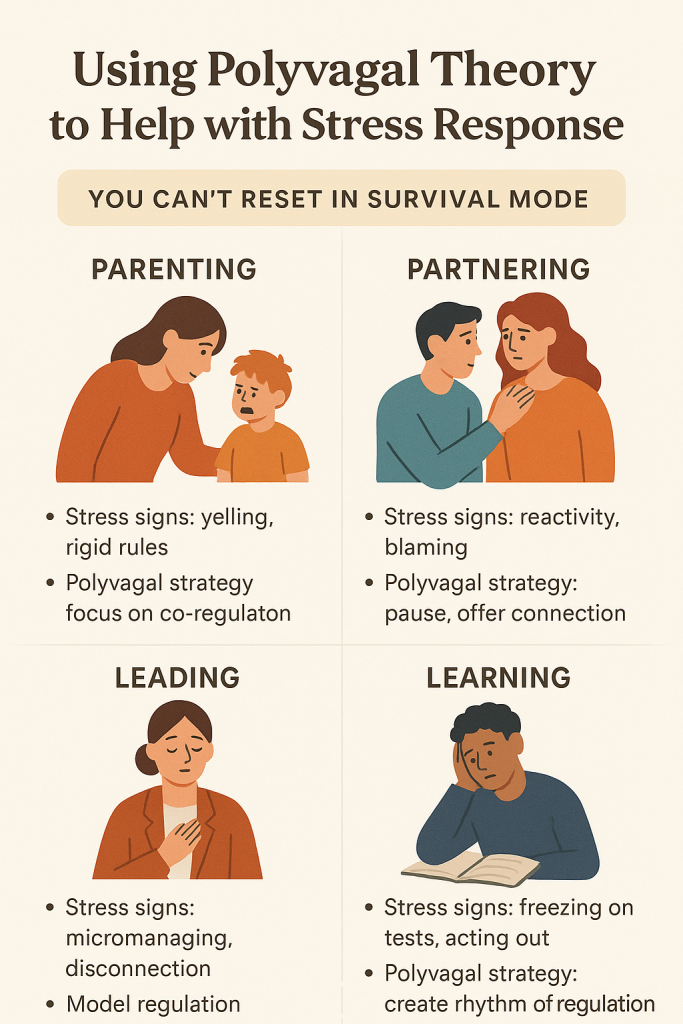
Señales de Estrés: Congelarse en exámenes, actuar.
Paso / Acción R – Regular: Comenzar la clase con un simple ejercicio de respiración o estiramiento. E – Encarnar: Modelar la relajación usando un tono tranquilo y postura abierta. S – Asentar: Permitir tiempo para que los estudiantes sientan sus cuerpos antes de sumergirse en tareas. E – Comprometerse: Ofrecer simples indicaciones de co-regulación (“Nota tu respiración…estás seguro”). T – Transformar: Ayudar a los estudiantes a construir sus propias herramientas de autorregulación para desafíos futuros.
Ejemplo de Liderazgo
Señales de Estrés: Microgestión, desconexión.
Paso / Acción R – Regular: Tomar una pausa antes de dar retroalimentación; respirar y verificar tu tono. E – Encarnar: Modelar liderazgo fundamentado suavizando la postura y expresión facial. S – Asentar: Nombrar tus propias emociones y asentarte antes de abordar problemas del equipo. E – Comprometerse: Usar escucha reflexiva y validar las perspectivas de otros. T – Transformar: Fomentar seguridad psicológica y modelar regulación adaptativa para el grupo.
Ejemplo de Crianza
Señales de Estrés: Gritar, reglas rígidas.
Paso / Acción R – Regular: Pausar y tomar 3 respiraciones lentas para bajar la marcha de tu propio sistema nervioso. E – Encarnar: Sentir tus pies en el suelo; notar dónde tienes tensión y suavizarla. S – Asentar: Sentarte o arrodillarte al nivel del niño para crear seguridad física y emocional. E – Comprometerse: Usar una voz tranquila, ojos suaves y palabras validadoras (“Veo que estás molesto”). T – Transformar: Solo después de la co-regulación, ayudar al niño a nombrar sentimientos y resolver problemas.
Ejemplo de Relación de Pareja
Señales de Estrés: Reactividad, culpar.
Paso / Acción R – Regular: Notar el impulso de discutir; respirar profundamente y aflojar la mandíbula/hombros. E – Encarnar: Sintonizar con las sensaciones de tu cuerpo en lugar de la historia en tu cabeza. S – Asentar: Crear espacio físico si es necesario, o tocar tu corazón o pecho suavemente. E – Comprometerse: Hablar desde la vulnerabilidad (“Me siento abrumado, no enojado”). T – Transformar: Cambiar del conflicto a la conexión reparando (“Quiero que nos sintamos cercanos de nuevo”).
Ahora vamos a anclarlo en el mundo real de situaciones emocionalmente cargadas – ya sean interpersonales, emocionales o sociales – lo hacemos más que un marco: se convierte en un ritual diario del sistema nervioso.
Aquí hay un conjunto de ejemplos que incluyen conflicto, basados en emociones y contextos sociales amplios y difíciles – cada uno seguido de cómo se puede aplicar RESET:
Conflicto: Lidiar con un Colega Difícil
Escenario: Te sientes desestimado en una reunión, tus ideas rechazadas con sarcasmo.
RESET en Acción: R – Regular: Apartarte brevemente, respirar profundamente o colocar tu mano sobre tu corazón. E – Encarnar: Notar las señales de tu cuerpo—mandíbula tensa, puños apretados—e intencionalmente suavizarlos. S – Asentar: Darle a tu sistema un momento para bajar antes de reaccionar. E – Comprometerse: Acercarte al colega más tarde, con tono firme y curiosidad en lugar de acusación. T – Transformar: Crear un límite o nombrar el impacto sin vergüenza, permitiendo espacio para la reparación relacional.
Emoción: Sentirse Abrumado por la Ansiedad
Escenario: Estás en espiral con pensamientos acelerados y opresión en el pecho antes de una gran presentación.
RESET en Acción: R – Regular: Usar trabajo de respiración (respiración cuadrada o 4-7-8) para señalar seguridad a tu cuerpo. E – Encarnar: Fundamentarte a través de tus sentidos—pies en el suelo, sosteniendo algo con textura. S – Asentar: Tranquilizar a tu sistema: “Esto es incomodidad, no peligro”. E – Comprometerse: Hablarte suavemente—”Puedo estar nervioso y aún así presentarme”. T – Transformar: Avanzar con coraje, notando cómo la autorregulación cambia tu energía.
Social: Ver las Noticias y Sentirse Sin Esperanza
Escenario: El peso de la guerra, la crisis climática o la injusticia desencadena impotencia o desesperación.
RESET en Acción: R – Regular: Alejarte de la pantalla. Deja que tu exhalación sea más larga que tu inhalación. E – Encarnar: Volver a tu cuerpo. Tocar algo vivo—una planta, una mascota, a ti mismo. S – Asentar: Sentarte en algún lugar tranquilo. Recordarle a tu cuerpo que la seguridad existe aquí y ahora. E – Comprometerse: Acercarte a alguien. Escribir un pensamiento. Hacer un pequeño acto de cuidado. T – Transformar: Comprometerte con una micro-acción que se alinee con tus valores, en lugar de quedarte congelado en el miedo.
Emoción: Navegando la Frustración Cuando las Cosas No Salen Según lo Planeado
Escenario: Vas tarde, nada funciona y tu paciencia se está agotando.
RESET en Acción: R – Regular: Nombrarlo—”Estoy frustrado”. Respirar hacia tu vientre. E – Encarnar: Sentir tus hombros; ¿están por tus orejas? Bajarlos. Sacudir la tensión. S – Asentar: Aceptar lo que es, en lugar de luchar contra la realidad. E – Comprometerse: Responder, no reaccionar—hablar a otros (y a ti mismo) con menos carga. T – Transformar: Terminar el bucle de reactividad. Preguntar: “¿Cuál es la siguiente cosa amable que puedo hacer?”
Conflicto: Sentirse Incomprendido en una Relación Cercana
Escenario: Has dicho algo importante, y la otra persona reacciona con actitud defensiva.
RESET en Acción: R – Regular: Pausar y tomar una respiración en lugar de escalar. E – Encarnar: Sentir el impulso de tu cuerpo de defender o explicar—¿puedes suavizar? S – Asentar: Decir, “Quiero entender. ¿Podemos ir más despacio?” E – Comprometerse: Cambiar de ganar a conectar—hacer una pregunta curiosa. T – Transformar: Co-crear una nueva forma de avanzar nombrando tanto tus necesidades como las suyas.
Emoción: Espiral de Vergüenza Después de Cometer un Error
Escenario: Cometiste un error en público y te sientes expuesto o humillado.
RESET en Acción:
R – Regular: Respira con la mano en el pecho—ofrécete calidez.
E – Encarnar: Observa si estás colapsando hacia adentro—eleva suavemente tu postura.
S – Sosegar: Dite a ti mismo: “Cometí un error. Sigo siendo valioso/a.”
E – Entablar: Acércate a alguien seguro y comparte tu experiencia sin editar.
T – Transformar: Usa la experiencia para aprender, no para castigarte.
A través del movimiento, la respiración, la atención plena y la presencia compartida, ahora aprenderemos a hacer RESET no solo en teoría, sino en el cuerpo.
Porque el cuerpo recuerda
Y quizás aquí está el corazón del asunto:
Como dijo Maya Angelou, “La gente olvidará lo que dijiste, olvidará lo que hiciste, pero nunca olvidará cómo la hiciste sentir.”
En las aulas, esto no es solo un sentimiento—es una verdad neurobiológica.
Antes de que un niño pueda pensar, debe sentir.
Descartes declaró: “Pienso, luego existo,” pero el sistema nervioso nos recuerda: Siento, luego puedo pensar.
Aprender no es simplemente una transacción cognitiva—es una experiencia de cuerpo entero.
La seguridad, la conexión, la co-regulación—no son extras; son la base.
Y cada vez que encontramos a un niño con presencia en lugar de presión, con sintonía en lugar de urgencia, invitamos a su sistema nervioso a calmarse, a abrirse, a confiar.
Porque lo que perdura no es solo lo que aprenden, sino cómo lo recuerda su cuerpo.
¿Quieres que lo adapte para una audiencia infantil o docente?
How Safety Shapes Learning Through the Nervous System
Understanding Polyvagal Theory, Co-Regulation, and the RESET Model for Autonomically -Informed Teaching and Leadership
Have you ever wondered why some information resonates deeply while other lessons seem to float away? Why certain teachers leave an indelible mark while others- despite their expertise – fail to connect?
The answer may lie not in pedagogy, but in biology.
I want to begin with a story—it’s a story about survival, connection, and how our bodies remember safety… or the lack of it.
The Babies Who Stopped Breathing
In the 1980s, a researcher named Stephen Porges was working with premature infants in neonatal intensive care units. These were babies who, on paper, were medically stable. They were breathing. Their vitals looked okay.
And then—suddenly—they would stop breathing.
Their heart rates would plummet.
And they would die.
Doctors called it “failure to thrive.” Some associated it with Sudden Infant Death Syndrome. But no one really knew why these tiny, vulnerable humans were shutting down.
Porges began to wonder: What if this wasn’t about disease? What if it was about the nervous system itself – reacting to overwhelming stress in a way we didn’t yet understand?
He began studying heart rate variability, which tells us something about how flexible and adaptive the autonomic nervous system is.
What he found was that the babies who were thriving had something very specific in common: high vagal tone – a strong, flexible parasympathetic nervous system, able to calm the body and recover from stress.
The ones who weren’t doing well?
They had low vagal tone. Their systems couldn’t bounce back. Under stress, they didn’t fight. They didn’t cry. They didn’t mobilize.
They shut down.
This insight led Dr. Stephen Porges to propose what we now call the Polyvagal Theory – a model that explains how the autonomic nervous system has evolved in layers:
The dorsal vagal system – the oldest part – responds to overwhelming threat by shutting down: collapse, dissociation, immobilization.
The sympathetic system – mobilizes us for fight or flight.
And the most recent, the ventral vagal system – unique to mammals—enables us to connect, co-regulate, express emotion, make eye contact, and feel safe in relationship.
Porges’s Paradox: When Connection Becomes Impossible
Here’s where the paradox comes in – and this is Porges’s Paradox:
The same system that allows us to connect, to feel safe, and to be present with others is the first to go offline when we feel threatened.
In other words: when someone most needs connection, support, and safety—their biology may prevent them from accessing it. Their body isn’t “misbehaving.” It’s doing exactly what it was designed to do to survive.
And so, as educators, therapists – indeed, anyone working with human beings – this theory offers a radical shift in perspective:
Behavior is biology.
Regulation precedes learning.
Safety isn’t a concept – it’s a felt state.
The Fundamental Shift: Reflex Before Reason
From this story there arises an invitation – an invitation to explore not just what people do – but what state their nervous system might be in when they do it.
Because from that lens, everything changes.
And here’s the key takeaway:
All behavior is fundamentally reflexive, not intentional.
Every interaction is a nervous system meeting another nervous system – driven first by reflexes, not conscious intention. Each time we meet, it is not minds but nervous systems that greet.
Reflex comes before reason. Instinct before intention.
This changes everything.
You are not met with words, titles, or intentions. You are met with tone. Pace. Posture. Breath.
What This Means in Practice:
Educators: You don’t teach a brain. You regulate a system. A dysregulated teacher can’t regulate a dysregulated child. Safety isn’t a strategy – it’s the curriculum.
Doctors: Your presence heals before your prescription. If the nervous system doesn’t feel safe, no truth lands, no trust builds.
Politicians: Policies are logic. But people vote from the gut. Speak to safety before strategy – or no one listens.
Lawyers: Argument lives in reason. But a client, a jury, a judge – they feel you first. You don’t win minds until you calm bodies.
Parents: Your children mirror your state, not your instructions. Calm is contagious. So is chaos.
Partners: Love isn’t heard through words. It’s sensed through presence. Regulate yourself, or you’ll co-create disconnection.
Humans: No matter your role – leader, friend, stranger – you are a nervous system in motion. You either bring safety or you don’t.
The Essential Question for Educators?
It’s not, “What did I mean?”
It’s always, “What did their body feel from me?”
Reflex before reason. Instinct before intention. Regulate before you relate.
The Educator’s Shift: From Content to Connection
If we shift the educator’s guiding question from “What did I mean?” to “What did their body feel from me?”, we stop asking what students understood and start asking what they absorbed – not with their intellect, but with their nervous systems.
Here are 10 powerful examples of that shift – felt, not memorized:
Did my presence feel safe or rushed? Not:Did I get through the lesson?
Did my tone invite curiosity or trigger defense? Not: Did they pay attention?
Did I feel grounded, or did I leak my stress into the room? Not:Was I organized?
Did my eyes say, “I see you,” or “Hurry up”? Not:Did I call on everyone?
Did my rhythm and breath soothe or speed them up? Not: Did they complete the task?
Did my silence feel spacious or threatening? Not: Did I give them enough wait time?
Did I move with calm authority or anxious urgency? Not: Was my classroom management effective?
Did my energy signal “you belong here” or “earn your place”? Not: Did I say the right words?
Did I bring warmth, or did I shield myself with neutrality? Not: Was I professional?
Did I regulate myself so they could co-regulate with me? Not: Did they behave?
Because long after the content fades, the body remembers:
How it felt to be in your presence.
That’s the real curriculum.
Understanding the Nervous System Through Polyvagal Theory
Your nervous system is constantly working behind the scenes, shaping how you experience the world. It determines whether you feel safe enough to connect, engage, and thrive – or if you need to protect yourself by shutting down or becoming reactive.
At the core of Polyvagal Theory are three organizing principles:
Co-Regulation – The biological imperative for connection.
Neuroception – The subconscious detection of safety or danger.
Hierarchy – The three predictable nervous system states:
Ventral Vagal: Safety and connection.
Sympathetic: Fight or flight.
Dorsal Vagal: Shutdown and collapse.
Co-Regulation: The Foundation of Connection
The nervous system is always scanning for an answer to one key question: Is it safe to connect?
We are wired to seek connection, but when our survival instinct overrides that drive, we withdraw or become defensive. Dr. Stephen Porges describes trauma as “a chronic disruption of connectedness.” Trauma, then, isn’t just about a single event -it’s about a nervous system that has learned to stay in protection mode.
Our nervous systems are shaped through interactions with others. Every moment, we send and receive cues – either signaling safety and co-regulation or reinforcing stress and survival patterns.
As Deb Dana states: “Our greatest responsibility—whether as parents, professionals, or simply as humans—is to cultivate a regulated nervous system and serve as a steady, grounding presence for others.”
Neuroception: How Our Nervous System Detects Safety and Danger
Unlike perception, which happens in our thinking brain, neuroception is our nervous system’s subconscious way of detecting cues from the environment, our body, and our relationships.
It operates in three domains:
Inside – Sensations from within the body (e.g., tight chest, relaxed breath).
Outside – Environmental signals (e.g., a loud noise, a warm smile).
Between – Social engagement (e.g., the tone of a voice, a facial expression).
Because neuroception is shaped by our past experiences, it’s not always accurate. Sometimes, we misinterpret safe situations as dangerous or fail to recognize real threats. For instance, a student might flinch when a teacher raises their voice slightly – not because there’s actual danger, but because their body remembers past trauma associated with similar sounds.
Hierarchy: The Three Pathways of Response
The nervous system operates in a predictable hierarchy:
Ventral Vagal (Safety & Connection)
Calm, engaged, connected.
The state where health, growth, and learning happen.
Sympathetic (Mobilization: Fight or Flight)
Activated energy, urgency, protection.
Can feel like anxiety, restlessness, or aggression.
Dorsal Vagal (Shutdown: Freeze & Collapse)
Numb, disconnected, low energy.
Can feel like exhaustion, dissociation, or depression.
The Body Leads, The Brain Follows
Understanding these three states becomes even more crucial when we recognize a fundamental truth about our neurobiology—one centered on an incredible structure called the vagus nerve.
What Is the Vagus Nerve? The Body’s Mission Control
The vagus nerve isn’t just any nerve -it’s the longest and most complex cranial nerve in your body, a superhighway of information extending from your brainstem to nearly every major organ. While we often think of nerves as simply carrying commands from brain to body (“move your hand,” “blink your eyes”), the vagus nerve operates more like a sophisticated two-way surveillance and response system.
Rather than the internet (which suggests equal upload and download speeds), think of the vagus nerve as a massive intelligence network with thousands of field agents (receptors throughout your body) constantly sending reports back to headquarters (your brain).
A staggering 80% of its fibers are afferent, meaning they carry information from your body to your brain, not the other way around (Porges, 2011; Visser et al., 1997).
This flips our understanding of perception on its head.
It means: Your gut feelings aren’t metaphors – they’re literal neural messages being transmitted through this remarkable nerve. When we say we feel “butterflies in our stomach” from anxiety or that something “doesn’t feel right,” that’s your vagus nerve delivering real-time intelligence about your internal state to your brain.
In other words:
Understanding doesn’t just happen in the head—it has to ‘sink in’ through the body. This isn’t poetic language; it’s biological reality. Your body is constantly “voting” on whether a situation feels safe or dangerous, and that vote reaches your brain through the vagus pathway before conscious thought even begins.
This revelation changes everything about how we approach learning and communication. When we try to reason with a student – or anyone – we can’t just tell them what to think or feel. They must feel it for themselves. Emotional resonance and safety must be experienced in the body before cognitive understanding can take root.
This is why phrases like “it has to sink in” are more than expression – they reflect the deep wisdom of our biology. The body must first signal safety before the brain can fully engage in higher-order thinking, creativity, and connection.
Understanding this hierarchy allows us to recognize where we are and, more importantly, find our way back up to connection.
Practical Tools for Nervous System Resilience
Since our automatic stories follow our autonomic states, the key to nervous system resilience is learning how to shift into ventral vagal.
Here are three core practices to regulate your nervous system:
1. The Essential “Notice & Name” Skill
Notice where you are on your nervous system ladder.
Name the state (Ventral, Sympathetic, or Dorsal).
Turn toward your experience with curiosity, not judgment.
Listen for a moment—what story is your nervous system telling?
2. The Three Stories Practice
Recall a moment of mild irritation.
View it through the lens of sympathetic (fight/flight)—what’s the story?
View it through dorsal shutdown—how does the story change?
View it through ventral connection—what shifts?
3. Finding Your Ventral Vagal Anchors
Identify your personal sources of regulation:
Who helps you feel safe and connected?
What activities reliably bring you a sense of ease?
Where do you feel most regulated?
When do you naturally find ventral vagal moments?
You Can’t Reset in Survival Mode
One of the most important insights from Polyvagal Theory is that reset and regulation are impossible when someone is stuck in survival mode. When the nervous system detects threat, it shifts into sympathetic (fight/flight) or dorsal vagal (freeze/shutdown) states. In these states, executive function, empathy, and learning shut down.
To truly “reset” or co-regulate, one must first exit survival mode and re-enter ventral vagal state, where safety, connection, and curiosity are possible. This is why trying to reason with someone who is triggered or shut down rarely works – their biology physically prevents the kind of receptivity needed for logical processing.
Final Thoughts: Building a Resilient Nervous System
Your nervous system already knows how to navigate these states. Resilience isn’t about staying in ventral vagal all the time – it’s about knowing how to find your way back.
As Thich Nhat Hanh reminds us:
“Earth will be safe when we feel in us enough safety.”
By cultivating nervous system awareness – both in ourselves and others- we create a foundation for co-regulation, connection, and change.
So, what’s one small shift you can make today to anchor yourself in safety and connection?
Remember, the path to understanding doesn’t start in the mind—it begins in the body.
Transition: From Understanding to Integration
Understanding Polyvagal Theory gives us a powerful lens for recognizing how safety, connection, and regulation shape every interaction. But insight alone isn’t enough. We need a reliable way to bring these concepts into our daily lives—to translate theory into practice, and biology into behavior.
That’s where the RESET model comes in.
RESET is a practical framework designed to help us recognize our state, regulate our nervous system, and return to connection—moment by moment, breath by breath. It allows us to pause, shift, and restore safety in ourselves and those around us.
Through real-world examples of the RESET model in action, we’ll explore how to embed nervous system literacy into everyday experiences—whether in a classroom, a courtroom, a family, or a friendship.
And as we begin to understand how to use RESET to shift our state, we’ll eventually turn toward a deeper practice: embodied learning—a way of knowing and integrating that moves beyond the mind and into the body itself.
Because once the body feels safe, learning doesn’t just happen. It lives.
Introducing the RESET Model
A Human Approach to Nervous System Resilience through Polyvagal Wisdom
Polyvagal Theory, developed by Dr. Stephen Porges, offers us a powerful lens to understand how our bodies and nervous systems respond to stress, connection, and safety. But let’s be honest – while the science is profound, it can also feel clinical or overwhelming. That’s why I created the RESET model – a simple, human-centered framework to integrate this life-changing theory into the everyday forms that matter most: parenting, partnering, leading, and learning.
RESET stands for:
R – Regulate
E – Embody
S – Settle
E – Engage
T – Transform
RESET isn’t just a strategy – it’s a rhythm.
It’s a way of coming back to yourself before reaching out to others.
Because unless we’re regulated, we can’t lead. We can’t connect. We can’t teach. We can’t love.
This model honors the truth that our reactions are often reflexive, shaped by our nervous system’s subconscious detection of safety or danger – what Polyvagal Theory calls neuroception. RESET helps us shift from survival to presence, from protection to connection.
Here’s the key:
You can’t RESET if you’re still in survival mode.
The first act is always Regulation.
From there, we embody awareness, settle the system, engage with presence, and create space for transformation – not just in others, but within ourselves.
Whether you’re facing a child’s meltdown, a partner’s withdrawal, a team’s resistance, or a student’s shutdown – RESET invites you to pause, return, and relate from a place of grounded safety.
This is how we bring the theory to life.
This is how we turn science into compassion.
This is how we become safe people who create safe spaces.
Learning Example
Stress Signs: Freezing on tests, acting out.
Step / Action
R – Regulate: Begin class with a simple breath or stretch exercise.
E – Embody: Model relaxation by using a calm tone and open posture.
S – Settle: Allow time for students to feel into their bodies before diving into tasks.
E – Engage: Offer simple co-regulation prompts (“Notice your breathing…you’re safe”).
T – Transform: Help students build their own self-regulation tools for future challenges.
Leading Example
Stress Signs: Micromanaging, disconnection.
Step / Action
R – Regulate: Take a pause before giving feedback; breathe and check your tone.
E – Embody: Model grounded leadership by softening posture and facial expression.
S – Settle: Name your own emotions and settle before addressing team issues.
E – Engage: Use reflective listening and validate others’ perspectives.
T – Transform: Foster psychological safety and model adaptive regulation for the group.
Parenting Example
Stress Signs: Yelling, rigid rules.
Step / Action
R – Regulate: Pause and take 3 slow breaths to downshift your own nervous system.
E – Embody: Feel your feet on the floor; notice where you hold tension and soften it.
S – Settle: Sit or kneel at the child’s level to create physical and emotional safety.
E – Engage: Use a calm voice, soft eyes, and validating words (“I see you’re upset”).
T – Transform: Only after co-regulation, help the child name feelings and problem-solve.
Partnering Example
Stress Signs: Reactivity, blaming.
Step / Action
R – Regulate: Notice the urge to argue; breathe deeply and loosen your jaw/shoulders.
E – Embody: Tune into your body sensations instead of the story in your head.
S – Settle: Create physical space if needed, or touch your heart or chest gently.
E – Engage: Speak from vulnerability (“I feel overwhelmed, not angry”).
T – Transform: Shift from conflict to connection by repairing (“I want us to feel close again”).
Now let’s anchor it in the real world of emotionally charged situation – whether interpersonal, emotional, or societal – we make it more than a framework: it becomes a daily nervous system ritual.
Here’s a set of examples that include conflict, emotion-based, and broad, difficult societal contexts – each followed by how RESET can be applied:
Conflict: Dealing with a Difficult Colleague
Scenario:You feel dismissed in a meeting, your ideas shut down with sarcasm.
RESET in Action:
R – Regulate: Step away briefly, breathe deeply, or place your hand over your heart.
E – Embody: Notice your body’s cues—tight jaw, clenched fists—and intentionally soften.
S – Settle: Give your system a moment to downshift before reacting.
E – Engage: Approach the colleague later, with steady tone and curiosity instead of accusation.
T – Transform: Create a boundary or name the impact without shame, allowing space for relational repair.
Emotion: Feeling Overwhelmed by Anxiety
Scenario:You’re spiraling with racing thoughts and tightness in your chest before a big presentation.
RESET in Action:
R – Regulate: Use breathwork (box breathing or 4-7-8) to signal safety to your body.
E – Embody: Ground through your senses—feet on the floor, holding something textured.
S – Settle: Reassure your system: “This is discomfort, not danger.”
E – Engage: Speak gently to yourself—“I’m allowed to be nervous and still show up.”
T – Transform: Step forward with courage, noticing how self-regulation shifts your energy.
Societal: Watching the News and Feeling Hopeless
Scenario:The weight of war, climate crisis, or injustice triggers helplessness or despair.
RESET in Action:
R – Regulate: Step away from the screen. Let your exhale be longer than your inhale.
E – Embody: Return to your body. Touch something living—a plant, a pet, yourself.
S – Settle: Sit somewhere quiet. Remind your body that safety exists here and now.
E – Engage: Reach out to someone. Write a thought. Make a small act of care.
T – Transform: Commit to one micro-action that aligns with your values, rather than staying frozen in fear.
Emotion: Navigating Frustration When Things Don’t Go as Planned
Scenario:You’re running late, nothing’s working, and your patience is wearing thin.
RESET in Action:
R – Regulate: Name it—“I’m frustrated.” Breathe into your belly.
E – Embody: Feel your shoulders; are they by your ears? Drop them. Shake out tension.
S – Settle: Accept what is, rather than fighting reality.
E – Engage: Respond, not react—speak to others (and yourself) with less charge.
T – Transform: End the loop of reactivity. Ask: “What’s the next kind thing I can do?”
Conflict: Feeling Misunderstood in a Close Relationship
Scenario:You’ve said something important, and the other person reacts with defensiveness.
RESET in Action:
R – Regulate: Pause and take a breath instead of escalating.
E – Embody: Feel your body’s urge to defend or explain—can you soften?
S – Settle: Say, “I want to understand. Can we slow down?”
E – Engage: Shift from winning to connecting—ask a curious question.
T – Transform: Co-create a new way forward by naming both your needs and theirs.
Emotion: Shame Spiral After Making a Mistake
Scenario:You made a public error and feel exposed or humiliated.
RESET in Action:
R – Regulate: Breathe with your hand on your chest—offer warmth to yourself.
E – Embody: Notice if you’re collapsing inward—lift your posture gently.
S – Settle: Say to yourself, “I made a mistake. I’m still worthy.”
E – Engage: Reach out to someone safe and share your experience without editing.
T – Transform: Use the experience to learn, not to punish yourself.
Through movement, breath, mindfulness, and shared presence, we will now learn how to RESET not just in theory – but in the body.
Because the Body Remembers
And perhaps this is the heart of it:
As Maya Angelou once said, “People will forget what you said, people will forget what you did, but people will never forget how you made them feel.”
In classrooms, this isn’t just a sentiment—it’s a neurobiological truth.
Before a child can think, they must feel.
Descartes declared, “I think, therefore I am,” but the nervous system reminds us: I feel, therefore I can think.
Learning is not simply a cognitive transaction – it’s a full-body experience.
Safety, connection, co-regulation – these aren’t extras; they are the foundation. And every time we meet a child with presence instead of pressure, with attunement instead of urgency, we invite their nervous systems to settle, to open, to trust.
Because what lasts is not just what they learn, but how their bodies remember.
At first glance, joy, presence, and resilience can sound like lofty ideals — the kind of words that belong on a wellness poster or a meditation app. When I first began working with these concepts, I didn’t feel particularly joyful. I felt tired. Overwhelmed. A bit skeptical, even.
Joy? In this world? With everything going on?
But what I’ve come to understand — through the lens of both neuroscience and lived experience — is that these aren’t traits you’re either born with or not. They’re not fixed qualities that some people just have and others don’t. They’re skills. They’re practices. They’re the result of consistent work with your nervous system, not the starting point.
They are the products of neuroplasticity.
The Brain’s Gift: Neuroplasticity
Neuroplasticity is the brain’s ability to change and adapt in response to experience. It means your brain — and by extension, your nervous system — is not static. It’s shaped by what you practice. Where you place your attention. How you respond to stress. What patterns you reinforce.
Every time you pause to take a slow breath in a moment of stress, you’re training your nervous system.
Every time you orient to safety — to the warmth in a room, the smile of a loved one, the feel of your feet on the floor — you’re giving your body a new experience.
And every time you choose to name a sensation, rather than get swept away by a story, you’re building the circuitry of self-regulation.
Joy, presence, and resilience are outcomes of this kind of work — this embodied work. They don’t arrive all at once. They emerge gradually, like strength after weeks of lifting weights.
Joy as Willingness
Joy is often misunderstood as a fleeting emotion — a kind of giddy happiness or positivity. But joy, in this context, is quieter. It’s the willingness to meet life as it is. To orient to what is good, even amidst challenge. It’s a muscle — one you can build. It doesn’t mean ignoring pain. It means allowing space for both pain and beauty. The nervous system supports this through the ventral vagal state — a state of calm connection and openness, which can be cultivated with practice.
Presence as a Discipline
Presence isn’t a passive state. It’s a discipline. It requires effort — especially in a world that constantly pulls us into the past or the future. Neuroscience tells us that the default mode of the brain is time-travel: running simulations, reviewing old tapes, predicting outcomes. Presence means interrupting this loop. It means returning to now — to the body, to the breath, to the world around us. It’s an active choice, one we can learn to make more often.
Resilience as Nervous System Regulation
Resilience doesn’t mean never getting knocked down. It means knowing how to come back. And the science is clear: our ability to bounce back is directly related to the flexibility of our autonomic nervous system. When we’re dysregulated — in fight, flight, or freeze — it’s hard to access our full intelligence. But with tools like grounding, orientation, and breath, we can restore balance. Over time, this becomes easier. We build a nervous system that knows how to return to safety.
You don’t need to be joyful all the time. You don’t need to be perfectly present. You don’t need to feel unshakable.
You just need to practice.
And that practice — like any journey — begins with a single step.
A breath. A pause. A willingness to meet yourself where you are.
Because joy, presence, and resilience aren’t far-off ideals.
They’re already within you. Waiting to be reclaimed.
What if the key to resilience, calm, and well-being has been inside you all along?
Enter the vagus nerve, a powerful link between your brain, body, and emotions.
Understanding it can help you reconnect with your natural ability to regulate stress, heal, and restore balancr.
It’s an essential part of being already mindful.
What Is the Vagus Nerve?
The vagus nerve is the body’s main communicator between the brain and internal organs. It runs from the brainstem through the throat, heart, lungs, and gut, influencing everything from digestion and immunity to mood and heart rate. Its name comes from the Latin word vagus, meaning “wandering,” and that’s exactly what it does—carrying vital signals throughout the body.
Most importantly, the vagus nerve is the brake pedal for stress. It counterbalances the “fight or flight” response (sympathetic nervous system) with the “rest and digest” state (parasympathetic nervous system). When your vagal tone is strong, your body can recover quickly from stress, regulate emotions, and maintain physical health. When it’s weak, stress lingers, leading to anxiety, inflammation, and burnout.
Why This Matters for Resilience and Mindfulness
In modern life, our nervous systems are constantly bombarded with stress—social pressures, work demands, and digital overload. The vagus nerve is designed to bring us back to safety, but if we don’t intentionally engage it, we can get stuck in a chronic stress loop.
By strengthening your vagus nerve, you activate your natural resilience. You remember what your body already knows: how to shift from stress to ease, from anxiety to clarity, from survival to thriving. This is mindfulness in action—not just noticing thoughts, but tuning into the body’s built-in capacity for balance.
How to Support Your Vagus Nerve
The good news? You don’t need anything external to restore balance—you already have the tools within you. Simple, mindful practices can enhance vagal tone:
• Deep breathing (especially longer exhales)
• Humming or singing (activates vagus signals in the throat)
• Cold exposure (like splashing cold water on your face)
• Gentle movement (yoga, stretching, or walking in nature)
• Social connection (safe, co-regulating relationships strengthen vagal tone)
Each of these practices helps you shift out of chronic stress and back into a state of presence, ease, and resilience—your natural state.
Coming Home to Yourself
Understanding the vagus nerve isn’t just about science; it’s about reclaiming your well-being. You are already equipped with the ability to regulate stress, to heal, and to feel at ease in your own body. The more you nurture this awareness, the more you remember what it means to be already mindful.
My partner and I went to a midday yoga class. Before that, we had only had smoothies—not a full breakfast, but enough to feel okay. The yoga session lasted about an hour and a half, and afterward, we wanted get something to eat. My partner asked how far the restaurant was, and I told her it was a 12-minute walk. Her response was immediate: That’s too far.
I reassured her it wouldn’t take long, and we started walking. But as we moved, she grew more anxious, worrying that we’d never get there, doubting the GPS, feeling lost in the uncertainty of when food would come. Eventually, she said, You should have dropped me off at the restaurant instead of making me walk.
At that moment, I could have attached a story to the situation. I could have told myself she was being overly dependent on me, that she should have planned her hunger better, that she was repeating an old pattern of learned helplessness. But all of that would have been my own mental narrative. The deeper truth was simple: Her body didn’t feel safe.
And that’s what she really needed to communicate—not why she was struggling, not a justification, not an argument. Just: My body doesn’t feel safe.
Breaking Free from Stories
So often in relationships, we attach explanations to our needs, either to justify them to ourselves or to convince someone else they are valid. But is it really necessary? Isn’t it enough to simply express what’s happening in our nervous system?
Instead of: • I haven’t eaten enough, and you should understand that. • I always get anxious when I don’t know exactly where we’re going. • Why would you expect me to walk that far?
We can just say: • My body doesn’t feel safe.
And instead of the other person responding with: • You should have eaten more. • It’s not actually that far. • You always do this.
They can respond with: • Okay, let’s pause. What do you need?
This shift can dissolve codependent dynamics. Instead of making it about blame or expectations—You should have planned better, I should have known better, you should have handled this differently—it becomes about presence. One person expressing a bodily state, the other responding with care.
How This Strengthens Relationships
In an intimate relationship, being able to name your nervous system’s state without justifying it can change everything. It removes defensiveness. It bypasses unnecessary conflict. It invites a response rooted in compassion rather than frustration.
Imagine if, instead of debating logistics or past patterns, a couple could simply acknowledge: Right now, my body doesn’t feel safe. That’s not a demand. It’s not an attack. It’s an offering of vulnerability.
This simple phrase can replace countless arguments, because at its core, nervous system resilience isn’t about rationalizing or persuading—it’s about recognizing what our bodies need and allowing space for that reality to be honored.
Other Ways to Express Nervous System Needs
If “My body doesn’t feel safe” doesn’t feel quite right, here are other ways to communicate what’s happening internally, without attaching a story: • I need to slow down for a moment. • Something in me feels unsettled right now. • I’m feeling dysregulated—can we pause? • I don’t feel grounded at the moment. • I need to find my balance before we continue. • I feel tension rising in me—can we check in? • My nervous system needs a moment to settle.
Each of these statements moves away from blame, away from justification, and toward shared awareness.
When we stop trying to explain why we feel the way we do and simply state what is, we invite connection instead of conflict. And that might be one of the most powerful ways to strengthen a relationship.