Posted on

resources to help your students manage distractions

What’s one problem educators experience every lesson? 

Distraction. 

Here are some resources to help. ##more##

Primarily aimed at students aged 14-17, these resources* include information on what mindfulness is, how to meditate, the benefits and neuroscience of mindfulness, and a long and short version of a meditation to practice with your class.

You don’t need to be a mindfulness teacher to deliver this lesson. You just need a willingness to explore mindfulness and its possibilities.
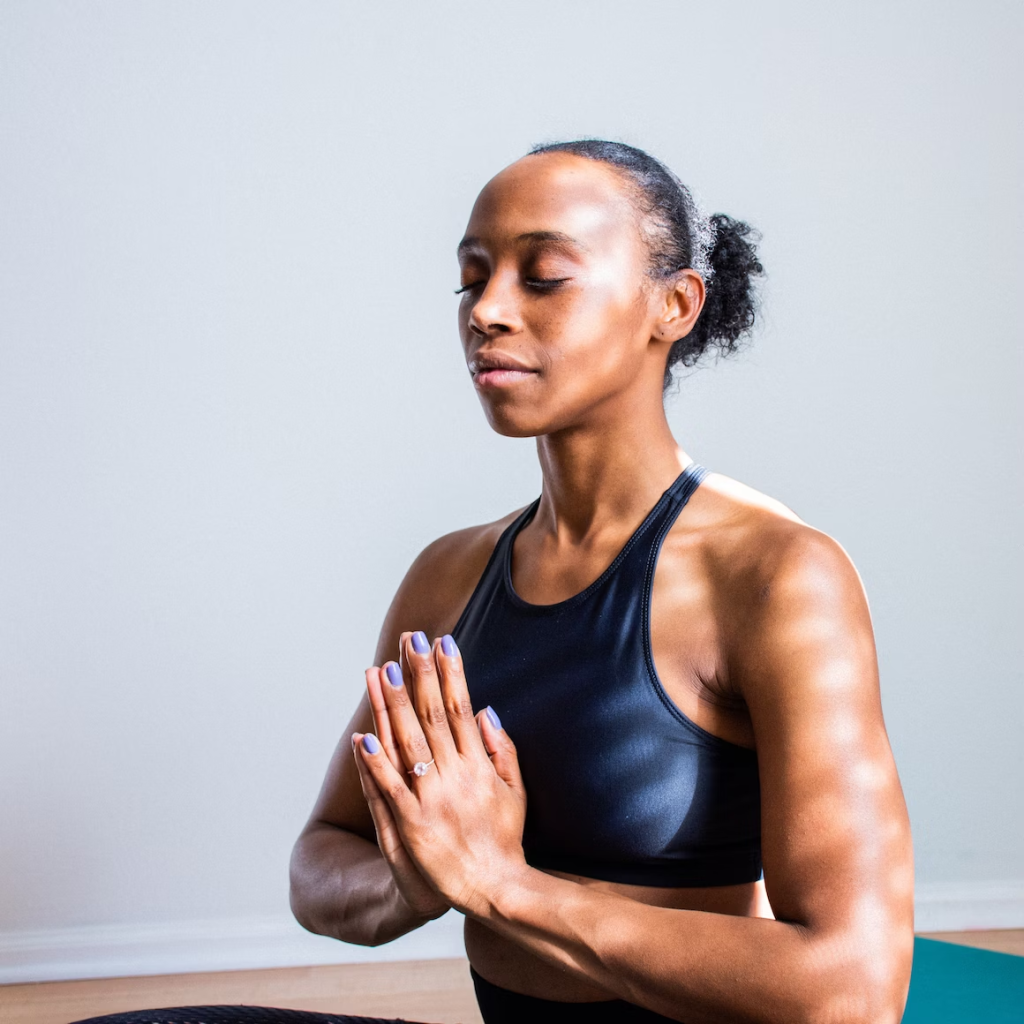
What is mindfulness?
Mindfulness is the basic human ability to be fully present, aware of where we are and what we’re doing, and not overly reactive or overwhelmed by what’s going on around us.
While mindfulness is something we all naturally possess, it’s more readily available to us when we practice on a daily basis. Whenever you bring awareness to what you’re directly experiencing via your senses, or to your state of mind via your thoughts and emotions, you’re being mindful. And there’s growing research showing that when you train your brain to be mindful, you’re remodeling the physical structure of your brain.

Ultimately, the goal of mindfulness is to wake up to the inner workings of our mental, emotional, and physical processes.


What is meditation?

Meditation is exploring what you are experiencing in the present moment. It’s not a fixed destination. Your head doesn’t become vacuumed free of thought, utterly undistracted. When we meditate we venture into the workings of our minds: our sensations (air blowing on our skin or a harsh smell wafting into the room), our emotions (love this, hate that, crave this, loathe that) and thoughts (wouldn’t it be weird to see an elephant playing a trumpet!).

Mindfulness meditation asks us to suspend judgment and unleash our natural curiosity about the workings of the mind, approaching our experience with warmth and kindness, to ourselves and others.

How do I practice mindfulness and meditation? 

Mindfulness is already here, already available to us in every moment, whether through meditations and body scans, or mindful moment practices like taking time to pause and breathe when the smartphone rings instead of rushing to answer it.

You are not your thoughts 
In this video piece, Jon Kabat-Zinn, creator of the research-backed stress-reduction program Mindfulness-Based Stress Reduction (MBSR), explains how mindfulness lights up parts of our brains that aren’t normally activated when we’re mindlessly running on autopilot. He explains: “Mindfulness is the awareness that arises through paying attention, on purpose, in the present moment, non-judgementally. And then I sometimes add, in the service of self-understanding and wisdom.”

Learning How to Meditate

At the outset, it helps to set an amount of time you’re going to “practice” for. Otherwise, you may obsess about deciding when to stop. If you’re just beginning, it can help to choose a short time, such as five or ten minutes. Eventually, you can build up to twice as long, then maybe up to 45 minutes or an hour. Use a kitchen timer or the timer on your phone. Many people do a session in the morning and in the evening, or one or the other. If you feel your life is busy and you have little time, doing some is better than doing none. When you get a little space and time, you can do a bit more.

Find a good spot in your home, ideally where there isn’t too much clutter and you can find some quiet. Leave the lights on or sit in natural light. You can even sit outside if you like, but choose a place with little distraction.

This posture practice can be used as the beginning stage of a period of meditation practice or simply as something to do for a minute, maybe to stabilize yourself and find a moment of relaxation before going back into the fray. If you have injuries or other physical difficulties, you can modify this practice to suit your situation.

How to Sit for Mindfulness Meditation

Take your seat. Whatever you’re sitting on—a chair, a meditation cushion, a park bench—find a spot that gives you a stable, solid seat, not perching or hanging back.

Notice what your legs are doing. If on a cushion on the floor, cross your legs comfortably in front of you. (If you already do some kind of seated yoga posture, go ahead.) If on a chair, it’s good if the bottoms of your feet are touching the floor.

Straighten—but don’t stiffen—your upper body. The spine has natural curvature. Let it be there. Your head and shoulders can comfortably rest on top of your vertebrae.

Situate your upper arms parallel to your upper body. Then let your hands drop onto the tops of your legs. With your upper arms at your sides, your hands will land in the right spot. Too far forward will make you hunch. Too far back will make you stiff. You’re tuning the strings of your body—not too tight and not too loose.

Drop your chin a little and let your gaze fall gently downward. You may let your eyelids lower. If you feel the need, you may lower them completely, but it’s not necessary to close your eyes when meditating. You can simply let what appears before your eyes be there without focusing on it. Be there for a few moments. Relax. Bring your attention to your breath or the sensations in your body.

Feel your breath—or some say “follow” it—as it goes out and as it goes in. (Some versions of this practice put more emphasis on the outbreath, and for the inbreath you simply leave a spacious pause.) Either way, draw your attention to the physical sensation of breathing: the air moving through your nose or mouth, the rising and falling of your belly, or your chest. 

Choose your focal point, and with each breath, you can mentally note “breathing in” and “breathing out.”
Inevitably, your attention will leave the breath and wander to other places. Don’t worry. There’s no need to block or eliminate thinking. When you get around to noticing your mind wandering—in a few seconds, a minute, five minutes—just gently return your attention to the breath.

Practice pausing before making any physical adjustments, such as moving your body or scratching an itch. With intention, shift at a moment you choose, allowing space between what you experience and what you choose to do.
You may find your mind wandering constantly—that’s normal, too. Instead of wrestling with or engaging with those thoughts as much, practice observing without needing to react. Just sit and pay attention. As hard as it is to maintain, that’s all there is. Come back over and over again without judgment or expectation.

When you’re ready, gently lift your gaze (if your eyes are closed, open them). Take a moment and notice any sounds in the environment. Notice how your body feels right now. Notice your thoughts and emotions. Pausing for a moment, decide how you’d like to continue on with your day.

That’s it. That’s the practice. It’s often been said that it’s very simple, but it’s not necessarily easy. The work is to just keep doing it. Results will accrue.

How Much Should I Meditate?
Meditation is no more complicated than what we’ve described above. It is that simple … and that challenging. It’s also powerful and worth it. The key is to commit to sit every day, even if it’s for five minutes. Meditation teacher Sharon Salzberg says: “One of my meditation teachers said that the most important moment in your meditation practice is the moment you sit down to do it. Because right then you’re saying to yourself that you believe in change, you believe in caring for yourself, and you’re making it real. You’re not just holding some value like mindfulness or compassion in the abstract, but really making it real.”
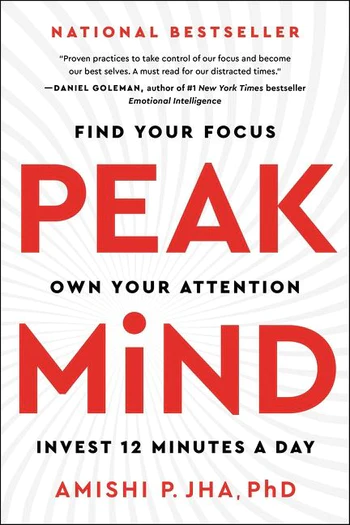


Recent research detailed in the book Peak Mind by neuroscientist Amishi Jha discovered that 12 minutes of meditation, 5 days a week, can protect and strengthen your ability to pay attention.


Why would I want to get better at paying attention?

Because you are what you pay attention to, and you are what you do with what you pay attention to. 

What you pay attention to is your reality.

Neuroscientist. Amishi Jha writes: paying attention to things is a bit like pointing a flashlight or searchlight. The light of your attention takes up all your focus. It’s all you see. It makes up the moments of your life. It makes up your life’s experience. 

Many of the lived moments of the 21st Century come with challenges to your attention. Smartphones, the internet, social media, electronic gadgets. These are all recent, new challenges to human attention. Add to that the more familiar challenges of family, friends, peer pressure, and your own thoughts, and you soon realise just how much our attention is being snatched away from us. In fact, it could be argued the most important skill we need to learn in the 21st century is the skill of being able to make better choices about where we place our attention.

Jha continues, “we can think of mindfulness as a cognitive training tool – or a cognitive workout – to help you make better choices about where your place your attention, how to strengthen your attention, and how to work with thoughts that take up our attention”.


Some Neuroscience about paying attention

One of the key areas of the brain associated with the capacity to pay attention is the Prefrontal Cortex (PFC) The cortex is the surface of the brain, and prefrontal refers to the area just behind the forehead. 

The PFC is one of the last parts of the brain to form in humans and is also one of the most complex. More than any other part of the brain the PFC distinguishes humans from other animals. It is one of the key brain regions involved in what is called executive functioning.

The PFC is like the control panel of the brain.

The prefrontal cortex and key executive functions

Thinking and reasoning.
Focusing and directing attention.
Cognitive flexibility.
Planning.
Problem-solving.
Short-term working memory.
Dorsolateral prefrontal cortex (DLPFC)
Impulse control.
Self-awareness.
Understanding emotional states.
Goal-directed behavior.
Orbitofrontal cortex (OFC)
Controlling intentional behavior.
Inhibiting inappropriate behavior.
Making decisions.
Anterior cingulate cortex (ACC)

Research shows that practising mindfulness activates many of the same brain areas as those that are active when we are engaged in executive functioning. 

The prefrontal cortex gets switched off when we are anxious or stressed. It gets overridden by more primitive brain areas such as the limbic system (the ‘emotional brain’) and even deeper structures commonly referred to as the reptilian brain.

Left unchecked, over the longer term the stress response can impair not only executive function but also biological functions such as appetite and sleep, physical illness, acceleration of the ageing process, mental disturbance and behavioural problems. This long-term wear and tear is known as ‘high allostatic stress’

Allostatic load refers to the cumulative burden of chronic stress and life events. It involves the interaction of different physiological systems at varying degrees of activity. When environmental challenges exceed the individual ability to cope, then allostatic overload ensues.

Awareness of Distractions meditation – to strengthen executive function

Now that you’ve been given information about mindfulness, the benefits of a meditation practice and some of the neuroscience, let’s do a meditation practice to experience ourselves how to better manage distractions. 

Try this practice. Just find a time and place where you won’t be distracted, and we’ll


After the meditation …
 try to recollect what type of thought distracted you from moment to moment during the meditation.

Here are some categories of distractions you might experience:
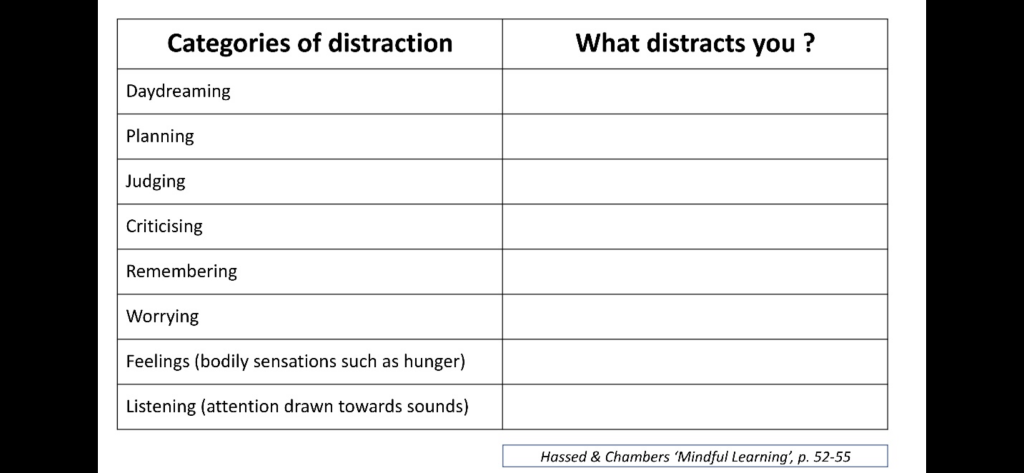


Hand out the above table after the meditation. Invite students to tick the categories of distraction that arose during the practice.

These categories can help you start noticing more clearly the kinds of things that distract you when you are trying to pay attention. 

It’s empowering to start noticing distractions that hijack your attention knowing you can bring this mindful awareness to your studies. 

For instance, you might be given a subject-based written exercise. You know you are going to have to bring your full focus to the task. However, you also know the mind can be distracted. It’s not a personal thing. It’s not you. It’s the nature of the mind’s design. You don’t need to give yourself a hard time. What you can do instead is bring an attitude of interested curiosity to what distracts you, notice it, write it down, then redirect your attention to the task once more. 

The mindful piece … fully acknowledging and accepting distractions without giving yourself a hard time.
Fully acknowledging and accepting distractions – in this case by writing them down – helps you to more easily and fully let go of the distraction, rather than getting caught up in it. 

Remember, distraction is normal. 

Normalising difficulties is one of the most important things that comes out of practicing mindfulness. Most of us think everyone else is fine – that distraction, self-criticism and procrastination happen only to us – so it’s a relief to know distraction affects everyone (including your teachers!) in similar ways.

* Resources 

https://www.mindful.org/meditation/mindfulness-getting-started/

https://www.mindful.org/mindfulness-how-to-do-it/

Hassed and Chambers, Mindful Learning: Reduce stress and improve brain performance for effective learning p.53

Images:unsplash.com

Lesly JuarezBrett JordanMadison Laverne, Levi XU

Posted on

educators, take note

 Historian Yurval Noah Harari responds to the question: 

What advice would you give to a smart, driven college student about to enter the “real world”? What advice should they ignore? 

Educators, take note 

‘Nobody really knows what the job market will look like in 2040, hence nobody knows what to teach young people today. Consequently, it is likely that most of what you currently learn at school will be irrelevant by the time you are 40.

So what should you focus on? My best advice is to focus on personal resilience and emotional intelligence. Traditionally, life has been divided into two main parts: a period of learning followed by a period of working. In the first part of life, you built a stable identity and acquired personal and professional skills; in the second part of life, you relied on your identity and skills to navigate the world, earn a living, and contribute to society. By 2040, this traditional model will become obsolete, and the only way for humans to stay in the game will be to keep learning throughout their lives and to reinvent themselves again and again. The world of 2040 will be a very different world from today, and an extremely hectic one. The pace of change is likely to accelerate even further. So people will need the ability to learn all the time and to reinvent themselves repeatedly – even at age 60.

Yet change is usually stressful, and after a certain age, most people don’t like to change. When you are 16, your entire life is change, whether you like it or not. Your body is changing, your mind is changing, your relationships are changing – everything is in flux. You are busy inventing yourself. By the time you are 40, you don’t want change. You want stability. But in the twenty-first century, you won’t be able to enjoy that luxury. If you try to hold on to some stable identity, some stable job, and some stable worldview, you will be left behind, and the world will fly by you. So people will need to be extremely resilient and emotionally balanced to sail through this never-ending storm and deal with very high levels of stress.

The problem is it is very hard to teach emotional intelligence and resilience. It is not something you can learn by reading a book or listening to a lecture. The current educational model, devised during the 19th Century Industrial Revolution, is bankrupt. But so far we haven’t created a viable alternative.

So don’t trust the adults too much. In the past, it was a safe bet to trust adults, because they knew the world quite well, and the world changed slowly. But the 21st Century is going to be different. Whatever the adults have learned about economics, politics, or relationships may be outdated. Similarly, don’t trust technology too much. You must make technology serve you, instead of you serving it. If you aren’t careful, technology will start dictating your aims and enslaving you to its agenda.

So you have no choice but to really get to know yourself better. Know who you are and what you really want from life. This is, of course, the oldest advice in the book: know thyself. But this advice has never been more urgent than in the 21st Century. Because now you have competition. Google, Facebook, Amazon, and the government are all relying on big data and machine learning to get to know you better and better. We are not living in the era of hacking computers – we are living in the era of hacking humans. Once the corporations and governments know you better than you know yourself, they could control and manipulate you and you won’t even realise it. So if you want to stay in the game, you have to run faster than Google. Good luck!’

Taken from ‘Tribe of Mentors: Short Life Advice From the Best in the World’ pgs 557-558. 

Harari’s ‘21 Lessons for the 21st Century’, p 313

Posted on

5 trauma-informed mindfulness practices for legal professionals

I have been in constant conversation with legal professionals throughout my life. My father was a lawyer. I have friends who are legal professionals. My partner is a lawyer. 

What do our conversations revolve around? What’s a constant theme? 

Grievance. Grief. Trauma. 

Legal professionals are continuously exposed to hurt, pained, anguished people. Because of this, legal professionals experience the effects of grievance and trauma in their own bodies. 

According to Canadian author and physician, Gabor Mate, trauma is a wound. It’s the wound of too much, too fast, too soon. It can be real. It can be imagined. I can be felt through the recalled experience of another. 

The Journal of Traumatic Stress
 reports that most of us will be exposed to a traumatic event. Roughly 90% of any given population will live through trauma, whether Post Traumatic Stress Disorder (PTSD) or complex trauma. 

My feeling is legal professionals should work on the basis that clients will be bringing a trauma history with them through their grievance. It could be small traumas they have had that could cause them to snap with their sense of grievance. Or they may feel a sense of shame. According to Peter Levine, psychotherapist and creator of somatic experiencing, shame has similar psychophysiological patterns that we see in trauma. Clients might be feeling a sense of shame that they have reached this point. I think we can safely assume that trauma and shame are continuously in the room for legal professionals.

So what can a legal professional do to navigate this constant?

First, take care of yourself. If you take care of yourself, you are better placed to take care of the clients you serve. 

Self-care starts with being trauma-informed

I want to offer some practical strategies using trauma-informed mindfulness practices that offer a safe place to reduce your stress and the stress of your clients. Yes, you are a coach. But more so, you’re a fellow human on this journey called life. You need to help yourself and your client feel safe and secure. 

Here are 5 practices I think might help. I call these practices the 5Cs. 

They are: Centredness – Calmness – Confidence – Clarity – Compassion 

1. Centredness can be found in the container of your body. You are not going to have an effective presence as an advocate, a coach, or an agent of self-representation unless you are present and in the container of your body. 

Let’s use the metaphor of a vessel – one that is centered, anchored, grounded, and moored, in a safe harbor. If you are tense you are going to go inside your head. You will get confused, foggy, and flustered. You are going to be either in fight or flight mode or shutdown mode. In doing this you narrow what is known as your Window of Tolerance

The 5Cs will help you open that window so you have a better chance of accessing clearer reasoning. You can do this in the following way:

Get grounded. Feel your feet on the floor. Your seat on the chair. Instead of feeling as though you are carrying the weight of the world, let the weight of the world carry you. 

Get a sense of your posture. I value this advice, from American psychologist and neuroscientist Stephen Porges: “If you move to an upright position, you trigger a change in blood pressure that makes you feel more alert and focused. A slight shift in posture can trigger neurophysiological circuits, and change how we react to the world, how we organize thoughts, and how we motivate ourselves”

Next, try a breath mantra: allow the breath to anchor you. As you gently breathe in and out, say, “Breathing in I calm body and mind. Breathing out I calm body and mind.” 

Then there is the experience of feeling sensations: feel sensations in the fingers. The lips. The eyes. This is somatic awareness. It helps you to shift attention away from the ruminative, anxious, thinking mind. 

Finally, listen to sounds: Allow sounds to be received. Sounds in the room, outside the room. Long sounds. Short sounds. Sounds within sounds.

2. Calmness: Once we are in the container of our body and centered, the body can attune itself to the physiological intervention of breathing in a way that is calming and soothing. Here we are using the superpower of the vagus nerve, responsible for the activation of the parasympathetic branch of the nervous system. We can use a specific breathing method called a 7/11. Count to seven on the inhale, then to 11 on the exhale. A gentler, extended exhale can help invite a sense of calm.

3. Confidence: Confidence is born out of calmness and acceptance. The acceptance of what is, rather than what if. This is a foundational attitude of mindfulness. From acceptance comes a willingness to confidently say “yes” to your experience; to be open and receptive – to accept the reality of ‘what is’.

4. Clarity. Clarity connects with purpose, a key intentional outcome of coaching. What is your purpose? What do you want to achieve? For instance, 

The doubt of “Can I?” becomes a purposeful “I can.” 

The uncertainty of “Do I?” becomes a certain “I do.” 

The trepidation of “Will I?” becomes the momentum of “I will.” 

The fear of “Am I?” becomes the fearless “I am.”

Try it now. Find the clarity of who you are by completing these sentence starters:

I am …

I can …

I will …

I do… *

5. Compassion: Each of these Cs leads to what the Dalai Lama refers to as the muscularity of compassion. According to Clinical Psychologist, Dr Chris Irons, compassion is the ability to understand, approach and engage with suffering and distress, as well as the desire and motivation to alleviate suffering, uproot its causes, and seek to prevent suffering in the future. 

First of all, have compassion for yourself. 

I find this powerful reframe from Jon Kabat Zinn helps: 

“As long as you are breathing there is more right with you than wrong with you, even when there is something wrong with you.” 


There is a refuge in such advice. It can also be reframed further: 

There is more right with this situation than wrong with this situation. 

There is more right with this conversation than wrong with this conversation. 

There is more right with this person than wrong with this person. 

The compassionate perspective reminds you: There is always more right than wrong. 

Outward compassion can take the form of seeing the person you are in conflict with as a nervous system. You can then see their behaviour as reflexive, not intentional. It is a product of their conditioning and neurotic organisation. This affords you the opportunity to reframe the experience of encountering the person you are in conflict with by de-personalising with inward and outward compassion. 

As for yourself, invite self-compassion: when feeling overwhelmed, place a hand on your heart & say: “There is still more right with me than wrong with me. This will pass. I’ll get through this.”

How do I practice the 5Cs? 

Bring the 5Cs into your everyday life. You know the every day trigger points in your life: getting the kids ready for school; a conflict moment with your partner; thinking about a future situation that is challenging; or even being caught up in traffic. You are gifted with such opportunities each day. The more you recognise situations as moments of opportunity to practice one or all of the 5Cs the more you lay down pathways known as Experience Dependent Neuroplasticity. You will be activating neurons and synaptic connections. In the famous phrase, you will be allowing neurons that fire together, to wire together. You will become stronger as a presence for yourself and others. 

However, don’t leave this to the last minute or put it on a checklist ‘to-do’. It doesn’t work that way. These practices are embodied. They need to be remembered by the body, not the mind. Also, don’t think you have to do all of these Cs. It might just be one C you want to practice. For instance, just grounding yourself, finding centredness through a modality that helps you find the space you need to come home to the clear mind and heart you already possess.

* This practice is taken from ’90 Seconds to a Life You Love’ Joan, I. Rosenberg

Posted on

meditation for calm and coherence

Breathing in a calm and coherent way can have a positive impact on your mind. Hopefully, you’ll start to experience this through this practice. ##more##

Find a place where you can sit comfortably upright and relaxed. Either on a cushion, a stool, or a chair. Ideally, sitting so that your knees are level with, or below, your waist. Get a sense of the spine upright, supporting you. This will help to keep your mind focused and alert. Let your hands rest on your lap or your legs. Whatever feels most comfortable for you. 

Neuroscience shows that something as simple as a slight shift in posture can, by triggering neurophysiological circuits, change how we react to the world, how we organize thoughts, and how we motivate ourselves.

What we’re doing here is a neurophysiological intervention that – through intention and commitment – can help you achieve a calm state of mind.

First, bring your attention to your breath.

Notice how you are breathing at this moment.

There are two key features of the breath that will bring you into a calm and coherent state.

The first involves your full diaphragm, by breathing into your belly.

So, if you place one hand on your stomach you should feel it rising with your in-breath and falling with your out-breath.

Feel this for a few breaths.

You might notice now that the mind is settling down a bit.

You are activating one branch of your parasympathetic nervous system, your ‘rest and digest’ mode. 

Carry on taking smooth breaths into the belly. 

You might start noticing the calming effect on the mind.

Keep practicing for the next 30 seconds or so.

Now we want to bring in the second feature of this practice.

This involves counting a fixed sequence of the in-breath and the out-breath.

We will count 4 on the in-breath and 6 on the out-breath.

We will inhale first

In 2-3-4.

And out 2, 3,4,5,6.

In 2,3,4

And out 2,3,4,5,6.

In 2,3,4.

And out 2,3,4,5,6.

Keep breathing to this sequence of 4 on the in-breath and 6 on the out-breath.

Feel the flow.

Breathing into your belly.

Alert and relaxed.

Enjoy the breath. 

Notice where it feels good in the body.

The mind can be calmed by the shape of your breath.

Enjoy calming your mind. 

Enjoy the confidence and clarity that arrives for you as you calm your mind in this way.

Posted on

mindfulness for educators

This mindfulness program has been developed for school educators and administrative staff. ##more##

Introductory Session

The introductory session offers an experiential exploration of what possibilities mindfulness may offer. It begins with the thinking (driven-doing) mode of mind, versus the sensing (mindful-being) mode.

Drawing on this, a conceptual framework is introduced which suggests the qualities of the two modes of mind. The thinking (driven- doing) mode of mind is the mode most of us identify with in our work context. This has many advantages. However, we want to explore whether opening to sensing (mindful-being) mode can increase our possibilities. 

Participants will be invited to do a sitting practice so they can experience sensing with curiosity and kindness. This practice offers opportunities to contemplate what mindfulness may have to offer. Supported by the inquiry & discussion which ensues, participants’ learning can be drawn out and underlined. 

The underlying theme of possibilities continues in the context of educators in particular. What are some reasons one might practice? What does a course look like? What is the evidence base? 

Some will be interested to explore how mindfulness can support the young people they work with. What would it look like in the classroom? 

However, to bring mindfulness to young people, we begin with ourselves as educators. 

By putting on their own oxygen masks through a course such as Mindfulness for Educators, participants can experience mindfulness and boost their own well-being. For some, this is also the start of the journey toward being able to teach mindfulness in an embodied, authentic way to students. For others, it will be about how to cultivate and integrate mindful awareness into your teaching experience.

The program unfolds as follows:

Session 1
Waking Up to the Autopilot.

Learn about:

Autopilot and the Costs of Habit and Inattention

Learn to:

Steady the attention through sensing body and breathing – finding an anchor in body sensations.
Practice FIRM, PATIENT, KIND, and REPETITION to train the muscle of attention.


Mindfulness starts when we recognize the human tendency to operate on automatic pilot, and begin to learn how best to step out of it. This is highlighted by the experience of eating mindfully and noticing the differences between the experience of this and our habitual, autopilot way of eating. This offers an example of how we can choose to tune into what our senses are telling us and engage in all the activities in our life, becoming more aware of our moments. 

The body is our great ally in this, and the foundation of all mindfulness training is the cultivation of embodied attention. By learning to gently drop attention again and again into the sensations of the body, we can practise grounding ourselves in the present moment of lived experience and not feeding difficult thoughts and feelings that can so easily carry us away. In this way, body sensations are a great place to anchor the attention and the first step in mindfulness training is to practise connecting with these and sustaining this connection. 

As well as an anchor, however, body sensations can also be a radar. It’s in the body that you can feel the first stirrings of emotionally charged thoughts. Instead of your body acting as an amplifier, it can become a sensitive early warning system that alerts you to unhappiness, anxiety, stress and fatigue almost before they arise. But if you are to learn to ‘read’ and understand the messages from your body, you have to learn how to pay attention, in detail, to those parts of the body that are the source of the signals. As you will soon discover, these signals can arise from anywhere in the body. This means you need to use a meditation practice that includes every region of the body, ignoring nothing, befriending everything. And for this we use the body scan. 

When we use the body scan we begin to recognise habits of mind and body, encouraging awareness of these with an attitude of patience and non-judgemental, friendly curiosity. 

However, it is also important to be aware of recent research coming out of the disciplines of neuroscience and interpersonal neurobiology that confirm that our teaching of meditation be informed by an understanding of how the nervous system works. A key finding here is to know about the mechanics of your own body, mind, past experiences, and the possible impact of trauma in your own life. 

Trauma is all around us. It will visit you in terms of your own life experience, inherited experiences, or in the people you serve and interact with. Therefore, it is important to be trauma-informed. The basis of being informed is to know that life, energy, aliveness, and arousal, run through your body all the time. This is not just a concept. It’s a lived experience. 

Visiting sensations in the body might not feel right for you at this moment. Awareness of that is important. So, a priority will always be to remind you to bring self-compassion to your own needs.

Session 2
Bringing Curiosity To Our Experience

Learn about:

Using the body as an anchor and radar.

Learn to:

Calm your mind by ‘anchoring’ it in the body.

Explore and befriend bodily sensations with curiosity and kindness.
Use bodily sensations as helpful indicators.


The first week of the mindfulness program began the process of building a capacity for sustained mindful concentration and awareness. It may have given you a glimpse into the mind’s inner workings and its tendency to ‘chatter’. For very good evolutionary reasons our mind tends to ‘chatter’ about what is going wrong, and this can easily hijack our attention and sweep us away towards anxiety.

The body is our great ally in not getting swept away by this chatter. As we have seen, the foundation of all mindfulness training is the cultivation of embodied attention. By learning to drop attention again and again into the sensations of the body, we can practice grounding ourselves in the present moment of lived experience and not feeding difficult thoughts and feelings that can so easily carry us away. In this way, body sensations are a great place to anchor the attention and the first step in mindfulness training is to practice connecting with these and sustaining this connection.

As well as an anchor, however, body sensations can also be a radar. It’s in the body that you can feel the first stirrings of emotionally charged thoughts. Instead of your body acting as an amplifier, it can become a sensitive early warning system that alerts you to unhappiness, anxiety, stress and fatigue almost before they arise. But if you are to learn to ‘read’ and understand the messages from your body, you have to learn how to pay attention, in detail, to those parts of the body that are the source of the signals. As you will soon discover, these signals can arise from anywhere in the body. This means you need to use a meditation practice that includes every region of the body, ignoring nothing, and befriending everything. And for this, we use the body scan.

Session 3
Mindfulness in Daily Life

Learn about:

Integrating mindfulness into movement and daily life

Learn to:

Bring mindfulness into movement.

Practice doing a short signature practice for this program.

Meditation is a particular activity distinct from others, whilst mindfulness can be practiced throughout the day: it is a particular way of doing whatever we’re doing. Deliberately practicing being present in the midst of activity – keeping connected with the sensations of the body, feeling breathing, noticing our state of mind and thoughts or impulses that may be strongly present – these are ways of bringing a quality of mindfulness and wakefulness into the midst of daily life.

Formal practice offers us practice in developing more control of our attention focus and approaching our experience and fostering the attitudes of curiosity, patience, and kindness towards our experience and ourselves. But we practice formally so that we can have mindfulness more readily available to us in our lives. So, intentionally bringing practice into our lives through short formal practices (such as the .b you will be taught) or by choosing to be present for everyday activities we do in our lives is an important part of this learning. 

Practicing shifting modes of mind with mindful awareness helps us to build flexibility and supports us in feeling which mode of mind supports us best in moments of life. We may find we are choosing to step away from unhelpful habits of thinking or doing that we notice or towards enjoyable experiences we notice.

Practicing being mindful whilst moving – in activities, walking, sport or creative pastimes – can enhance these experiences and even support a sense of flow and ease in the midst of what we’re doing. We are learning to recognise that mindful awareness can be present in both stillness and movement in our lives. We are developing skills through ‘formal’ practice so that they can be more available in our daily lives.

Session 4
Tuning in to Thoughts & Feelings

Learn about:

Thoughts: how influential they are and how we can learn to relate to them more mindfully and skilfully

Learn to:

Recognise patterns of worrying and overthinking and the effects that these have.

Practise unhooking from such patterns so as to find more freedom in relation to difficult thoughts.

This session highlights the possibility of relating differently to thoughts and so discovering a new freedom in relation to this powerful aspect of our experience that so often controls and inhibits our lives. It’s the movement from viewing thoughts as facts to recognising them as mental events that come and go in our awareness, even when the thoughts and the feelings accompanying them are unpleasant or strong.

Learning to step back from, or decentre, from our thoughts allows us to see them clearly and decide whether or not to listen to their story. With awareness, we can see the interconnections of thoughts, moods, body states and actions we take, and loosen the grip of habitual reactivity. We can begin to recognise habitual thought patterns such as self-criticism or problem-solving strategies and learn to respond to these well-worn mental grooves with kindness and wisdom. We can begin to choose which “thought bus” we board as we wait in the station rather than getting on every bus that arrives, even if we don’t want to go to the destination to which it will inevitably take us. 

In this session, this changed relationship is highlighted both by ‘didactic’ learning about ways of relating to thoughts and also by practicing this new relationship through the Sounds and Thoughts meditation and the Thought Bus exercise. 

Session 5:

Exploring Difficulty: Building Resilience.

Learn about:
How turning towards feelings of difficulty can help.

Learn to:

Identify your stress signature in order to cope more skillfully.
Befriend and breathe with sensations of stress so as to respond rather than react.


The whole mindfulness course so far has been building to this point. The invitation now is to use the attention-based skills cultivated in the first four weeks of the course to turn towards and befriend aspects of experience that we might otherwise avoid or work hard to fix because they are uncomfortable and because, as human beings, we are hard-wired to do so.

So far in the course, we have been exploring bodily sensations as the arena for turning towards difficult experiences, and we continue to do this in this session. Curiosity & kindness, allowing and accepting are the keys to doing this in ways that alleviate rather than add to suffering, helping us to respond rather than to react.

In this session, we explore the belief that human stress is created by the way that we see and respond to challenging circumstances, rather than necessarily the circumstances themselves. It is normal and natural to react to threatening situations, but recognising and stepping back from automatic reactivity to choose wisely responding allows us to build resilience and steadiness in the midst of life’s storms.

Reminding yourself of your own practices when difficulty is present in your life is an essential foundation to offering this part of the course with embodied presence, integrity, and genuineness.

We can teach this way of being with difficult experiences because we have first-hand experience of working with it this way ourselves.

Session 6

Relating to Ourselves and Others

Learn about:
How our mindfulness practice can include our communications with others.

Learn to:

Cultivate an attitude of kindness towards yourself and others through the Befriending practice.
Bring mindful awareness to relating.


Being with other people can be both wonderful and highly challenging. As we practice mindfulness we notice our tendency to relate to ourselves and others using habitual patterns of thinking and acting which may be outdated or unhelpful. Mindful awareness can allow alternatives to become available. Many of us, and especially if we work in a school, spend most of our waking day in relationship with other people. This class offers a chance to explore how we can support this aspect of our lives with mindfulness practice. This is the chance to practice with our eyes open, including another person in our field of focus as we practice. 

In this lesson, we build on the previous exploration of noticing, awareness, and recognition of habitual and personal patterns of body and mind. We extend the learning about skillful ways to relate to difficulty, and especially the attitudes of friendliness and curiosity that support this. The possibility to open to or turn towards even challenging circumstances, internally or externally as we are in connection with others, is explored through the image of a petal opening in the Petal Practice. The physical opening in this practice is connected to the invitation to be open to ourselves and others through attitudes of friendliness and acceptance. 

Kindness transforms things: the ‘aversion’ pathways in the mind are switched off and the ‘approach’ pathways are switched on instead. 

This change in attitude enhances openness, creativity, and happiness, while at the same time dissolving the fear, guilt, anxiety, and stresses that lead to exhaustion and chronic discontent.

Session 7

Developing Balance In Our Lives

Learn about: How you can boost your mood and well-being through your choices both about whatthings you do and how you do them.

Learn to:

Recognise how we deplete ourselves in daily activities and how awareness can allow us different choices.
Integrate more nourishing activities into your life.
The central question in this session is “How do I spend my time, and do the choices that I make about this really support my well-being and that of those around me?” 

It’s a challenging question, especially when our lives are so busy, but it seems important to ask it regularly so that we don’t just let the weeks, months and years slip by in an autopilot state of busyness. Mindful awareness can offer us a deeper connection between how we are in this moment and the choices we make about what we do and how we act. With mindful awareness we can also tune in to the way we do activities in our lives as much as what we do. 

This session allows time to reflect on the ratio of ‘nourishing’ to ‘depleting’ activities in a typical day. In this class, we’re invited to consider how to make adjustments to shift this ratio, or to let ourselves be more nourished by the nourishing things and less drained by the depleting things. 

This is often about becoming more aware of the mode of mind in which we do both nourishing and depleting activities: to do activities mindfully tends to mean that we’re more open to nourishment and less likely to wear ourselves down with the resistance and unconsciousness that often accompany depleting activities.

Session 8
Mindfulness And The Rest of Your Life?

Learn ways to: 

Identify what you’ve learned from doing this course.
Consider what advice you’d give to your future self and what you’ll continue to practice.

In the last class, we explore that, through mindful awareness, we can learn to sense and then respond to times when we, and the activities in our lives, are out of balance. The need to monitor this balance as it constantly shifts becomes apparent: balances are of course always dynamic. 

It is this ongoing need for awareness and skilled responding that we are especially encouraging in this last class. Participants reflecting back on their learning from the course, and awareness of how things are currently, inform the choices each participant makes about how mindfulness may fit into the rest of their lives. The learning from the course is drawn on throughout this session, honouring their completion of the course and readiness to continue with their mindfulness practice once the course has ended.

Posted on

mindfulness program for elementary schools

Developed by leading mindfulness teachersPaws b is a practical and fun classroom introduction to mindfulness. ##more## At the most basic level, Paws aims simply to be an awareness-raising exercise that gives 7-11 year-olds a taste of mindfulness, so they know about it, and can thus return to it later in life, learning more about it when this is useful to them. 

The most fundamental aims are: 

For all children to know about mindfulness. 

For most to enjoy it. 

For many to use it now and again. 

For some to practise daily. 

For as many as possible to remember it.

Here are the learning intentions for each lesson:

Lesson 1: Our Amazing Brain!Learning Intention:
To introduce the idea of the mind and the brain as separate but connected.
To explore how the brain can be changed depending on how we train our minds.
To experience what it’s like to direct the attention.
To provide some simple tools for training attention.

Lesson 2: Making Choices
Learning Intention:
To recognise that we have to make many choices in a day.
To understand that we can train our brain to be aware of when we make those choices. 
To begin to train the mind in order to become more aware of our feelings and thoughts which can affect the choices we make.
To begin to recognise when there is an opportunity to make skillful choices

Lesson 3: Puppy TrainingLearning Intention:
To introduce the idea of the faculty of attention.
To experience how we might direct our attention.
To understand the untrained mind’s fickle nature – it is like a puppy!
To learn some simple tools for training attention with attitudes of kindness, patience, and repetition

Lesson 4: Everyday MindfulnessLearning Intention:
To introduce the idea of autopilot
To explore how we can step out of autopilot when we choose to.
To understand the role of the hippocampus in connecting previous experiences with current ones.
To explore the everyday experience of stopping and ‘checking in’ with present-moment awareness.

Lesson 5: Noticing the WobbleLearning Intention:
Recognising that we all wobble.
Expanding breath awareness practices –finger breathing.
Exploring how to notice the wobble, and finding ways to steady ourselves.
Understanding how the Insula works with the Prefrontal Cortex helps us do this.

Lesson 6: Finding a Steady PlaceLearning Intention:
Recognising how we notice when we (and others) wobble.
Learning how to steady ourselves when we notice the wobble.
Exploring settling attention in the lower half of the body as an anchor or steady base.

Lesson 7: Working with DifficultyLearning Intention:
Introducing the amygdala – learning to deal skilfully with difficulty.
Exploring the nature of mind and human patterns of reactivity.
Taking responsibility to keep the mind and body safe and healthy by choosing a response.

Lesson 8: Choosing Your PathLearning Intention:
Understanding when Fight/Flight/Freeze are important and when they are less helpful.
Exploring the difference between reacting and responding.
Practising pausing and choosing a different path.
Beginning to explore self-care and compassion – can we be kind to ourselves as well as others?

Lesson 9: The Storytelling MindLearning Intention:
Exploring the nature of the mind (trying to make sense of, filling in the gaps, telling us stories).
Learning to recognise thoughts (metacognitive awareness).
Beginning to explore decentring from thoughts –thoughts are not facts.

Lesson 10: Stepping Back:Learning Intention:
Understanding how thinking about what might be can exhaust us.
Learning to recognise how this can combine with body sensations, moods, and actions.
Exploring how to use practice to steady and step back from difficult thoughts.

Lesson 11: Growing Happiness.Learning Intention:
Exploring how we can nurture ourselves and others.
Learning how to make room for and choosing happiness in our lives.
Noticing the details of the experience of happiness.
Sharing happiness.

Lesson 12: The Yum FactorLearning Intention:
Learning how to shift attention towards pleasant experiences.
Understanding how savouring these experiences can increase levels of happiness.
Recognising the Paws b journey and recalling what we have learned.

Posted on

mindfulness program for secondary students

Developed by leading mindfulness teachers,.b (pronounced ‘dot-be‘) is a classroom introduction to mindfulness for secondary students. 

At the most basic level, .b aims simply to be an awareness-raising exercise that gives all students a taste of mindfulness, so that they know about it, and can thus return to it later in life, learning more about it when this is useful to them. 

The most fundamental aims are:

– For all students to know about mindfulness

– For most to enjoy it

– For many to use it now and again

– For as many as possible to remember it.

– And some to practise daily

The primary objective is for students to have a positive experience of mindfulness. For some students, this might be a life-changing experience, but not for most, so at a superficial level, it is about them enjoying it. Having said this, if you can make mindfulness relevant to their lives now, they will often engage with it and use it almost immediately. 

For some students, mindfulness can help them to achieve their goals, such as focusing in class, improving performance in sports, or getting on with others. For others, mindfulness can become a lifeline to help them deal with present difficulties, such as coping with exam pressure and other causes of anxiety and distress.

Here are the learning intentions for each lesson:

Introduction to Mindfulness
Learning Intention:
To introduce mindfulness in a way that is engaging, entertaining and persuasive.

For students to have their first taste of mindfulness practice, specifically to:

1. ‘Play attention’ via mindfulness of hands

2. Do a ‘.b’ (the signature practice for this program)

This is a lesson to help persuade the class why it is a good idea to learn mindfulness.

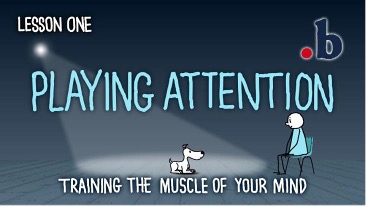
Lesson 1: ‘Playing Attention’.

Learning Intention:

To introduce students to the faculty of their attention.

To experience that they can direct their attention.

To understand the untrained mind’s fickle nature –it is like a puppy.

To begin to provide some simple tools for training attention.

To introduce key attitudes to attention-training, such as kindness, patience, and repetition.

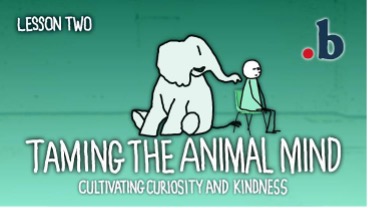
Lesson 2: Taming The Animal Mind.

Learning Intention:

To explore that the mind has a life of its own – we often can’t control it.

To nurture an attitude of curiosity, kindness, acceptance, and openness that helps us to deal more skilfully with these fluctuating mind-states.

To teach that by ‘anchoring’ our attention in the lower half of the body we can begin to turn towards calm even when our minds are stormy.

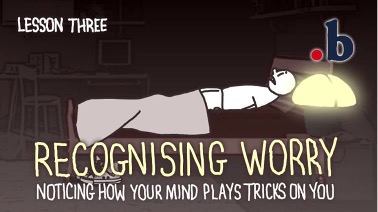
Lesson 3: Recognising Worry.

Learning Intention:

To understand how the mind habitually interprets and ‘tells stories’ about what is happening.

To recognise how we can get ‘stuck in our heads’ and ‘ruminate’ or ‘catastrophise’.

To learn about how rumination is not only ‘stressful’ – it affects our bodies and behaviour, from sleep and sport to spots and studies.

To explore how practices like the ‘7-11’ and the ‘Beditation’ can help us deal with this by switching
us from ‘thinking’ mode to ‘sensing’ mode.

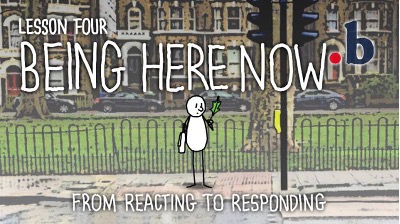
Lesson 4: Being Here Now.

Learning Intention:

To explain how ‘autopilot’ prevents us from being alive and awake to our experience in
the here and now.

To learn to appreciate and savour the pleasant. 

To learn how to respond rather than react to the unpleasant.

To learn how a .b can quickly bring our attention into the here and now, and help us to respond rather than react to what is difficult.

Lesson 5: Moving Mindfully.

Learning Intention:

To learn that Mindfulness is also about movement.

We spend a great deal of time doing actions ‘mindlessly’… on autopilot.

One such activity is walking. We are rarely ‘present’ when we walk, or move in general.

Learning to move mindfully can also be used as a resource for peak performance in sport, music, and the performing arts.

Lesson 6: Stepping Back.

Learning Intention:

To understand we have the capacity to ‘step back’ from our thoughts.

Learn that it can be helpful to see thoughts as ‘traffic’ flowing through the mind.

Identify some of the particular ‘thought trains’ that pass through the mind.

Recognise we don’t have to ‘get on the thought train’ when difficult thoughts arise.

Lesson 7: Befriending The Difficult.

Learning Intention: 

To understand stress: where it comes from, why it is necessary, how it works and the potentially harmful effects.

To identify and draw our “stress signature” – where in the body do we feel stress? 

To learn to respond rather than react, by ‘turning towards’ and ‘being with’ difficult emotions.

Lesson 8: Taking in The Good.

Learning intention:

To encourage an appreciation of what is good in life.

To explain how even the ordinary can be experienced as ‘good’ if we are more fully
aware of it.

To teach the advice of those who have done this even in awful circumstances.

To teach a practice of “taking in the good” so that what ‘good’ turns from an idea into
an experience.

Lesson 9: Pulling It All Together.

Learning Intention:

To identify what students have found most useful in the .b course.

To consider in what areas of their life they might apply their new mindfulness skills.

To give feedback on the course.

Posted on

The Present – a mindfulness program for elementary school educators

The Present is a spiral program that enables Elementary schools to introduce mindfulness and well-being in an incremental way; supporting learning across the curriculum and throughout the elementary school years. ##more##

The program has been developed by Sarah Silverton (mindfulness teacher, trainer, and author), Tabitha Sawyer (elementary school teacher and assistant principal), and Dusana Dorjee (neuroscientist and researcher).

The Present
 is designed for educators working with elementary-aged children in schools. It weaves learning about mindfulness, well-being, and neuroscience into activities that typically take place throughout a school day, as well as at home.

The materials aim to develop:

metacognitive awareness,
attention regulation skills,
emotion regulation skills,
non-judgement and non-reactivity in relating to experience,
noticing and savouring positive experiences,
qualities of kindness and openness in relating to self and others


To build understanding and skills for both adults and children, The Present materials offer a shared exploration of seven themes:

Here and Now 

Focusing 

Choosing

Connecting

Human Body

Human Mind

Noticing Change


Learning about neuroscience, well-being, and mindfulness is developed through storytelling, suggested practices for each theme, inquiry, and everyday activities such as eating, walking, relating to other people and even lining up! 

The emphasis is on how we do things rather than what we do and on experiential learning rather than that which is primarily conceptual. 

The Present
 incorporates the latest evidence from neuroscience, including new understandings of brain development from the ages of 3-11, and the impact of mindfulness and attention on emotion regulation. In doing so, The Present program recognises the evolving needs of children as they progress through elementary education and is relevant to each particular age, as they encounter the joys and rituals of everyday life. 

In recognition of the challenges and demands of the role of an elementary school teacher, the materials are also offered in a way that is accessible to busy teachers and offers support to them, as well as the children.

Posted on

everyday mindfulness 10 week program

Why the Everyday Mindfulness 10-Week Program?

Because of the benefits. 

These include: 
• Reducing stress. 

• Alleviating anxiety or depression. 

• Building self-awareness. 

• Developing emotional regulation skills. 

• Growing in self-compassion. 

• Feeling more present and connected to yourself and others. 

• Achieving peak performance. 

• Sharpening cognitive function. 

• Growing in mental, emotional, and spiritual health. 
##more##

My goal is to support you in growing a mindfulness practice that makes sense for you through evidence-based techniques in a concise and comprehensive way that will allow you to quickly integrate mindfulness into your personal and professional life. For instance, in your professional life, it might mean integrating mindfulness into your company’s professional development, your current consulting or coaching offers, your therapeutic practices, or your teaching repertoire. In your personal life, it might mean bringing everyday mindfulness into relationships with your children, your partner, your parents, your siblings, or your neighbors. Ultimately, by sharing these practices with just one or two people you can offer tremendous healing and resilience for yourself and to the people who are significant to you in your life. Why wouldn’t you want to invest in such an opportunity? 

After all, what are the alternatives? 
They are the negative consequences of a lack of mindful awareness. 

These can include: 

• Carrying tension and stress in the body, or holding on to unpleasant moments. 

• Missing out on positive or pleasant moments. 

• Missing information to make good decisions. 

• Losing objectivity due to mood-changing interactions.

What is Mindfulness? 

The tenets of mindfulness stretch back to Vipassana, an ancient Indian meditation technique, rooted in self-observation and seeing things as they truly are.Today, mindfulness practices are grounded in both ancient teachings and modern science. Neuroscience, psychology, and physiology research all contribute to our understanding of how the body responds to its environment, stimulus, other people, and our own thoughts. Research into self-compassion (Serpa and Wolf, 64) suggests a relationship between self-compassion and lowered depression, anxiety, and perceived stress, in addition to self-compassion supporting health, health-related behaviors, managing chronic pain, and defending against the emotional impact of illness

I always return to this definition by Jon Kabat-Zinn, the founder of Mindfulness-Based Stress Reduction (MBSR). 

“Mindfulness is paying attention, on purpose, in the present moment and nonjudgmentally.” 

I want to emphasize the non-judgmental aspect of paying attention to the present moment. Our goal is to allow our experience, our emotions, and our thoughts to simply be. That means we acknowledge and witness without trying to fix, react, cope, or medicate what is happening in the moment. 

How often do we feel guilty for what we’re feeling? Or grow anxious about our own thoughts? 

Awareness infused with judgment is not mindfulness. 

Non-judgmental moment-to-moment awareness of our experience is truly healing and empowering. 
When we can encounter the moment, pleasant or unpleasant, with an open sense of curiosity, this will be our paradigm shift. 

Mindfulness is cultivating process, not outcomes 

Of course, we all want to find calm, creative openness and presence. We want to de-stress, relieve anxiety, and feel better. But be careful about focusing too much on those outcomes. Mindfulness is about the now, not fixing what’s in the way of achieving what we want. In fact, mindfulness is not about achieving anything. The paradox is that focusing on the process and cultivating a mindfulness practice will get us to the outcome faster. 

Being present and attentive to what’s going on inside us requires simply being in our bodies. This is more challenging than it sounds. We’re used to experiencing our body through our heads, whether in the form of negative self-talk, rushing to diagnose, or trying to fix the experience. Can we instead truly be in our bodies? Can we notice and sit with our anxiety, shame, fatigue, depression, anger, stress, or joy? Can we be in the moment with openness and curiosity instead of fuelling the story behind it with blame, resentment, or fear? 

The answer is yes, we can. In time and with practice, we can all achieve mindfulness and enjoy its many benefits.

You are already mindful 
Mindfulness is about remembering a capacity already within you. Essentially, it starts with this breath, this body, right now. All the moments you have lived have evaporated. You are the product of the accumulated moments you have experienced up to this moment now. These moments are often used by the mind to create a narrative of you that is far removed from the real you. Mindfulness invites you to seek the other story within the story you are telling yourself about your life. To illustrate this, let me share my own journey into mindfulness. 

My story 

I was a sensitive, withdrawn boy. Looking back, I realise that my sensitivity was really a gift, but it got siphoned by circumstances in my life, namely family illness that was chronic and debilitative for myself, my mother, my sisters, and my poor father who was cruelly struck down at an early age with multiple sclerosis. Added to this was my exposure to a school education where some of the teachers were brutal and ignorant. For instance, I had a form tutor who frightened, threatened, and abused students. He was later imprisoned for this. I experienced shame and trauma in that school. I didn’t know it was shame and trauma until later in life, I just thought I was an unhappy kid who felt profoundly uncomfortable in his body, little knowing that discomfort was my nervous system trying to protect me. For me the co-joined experiences of my father’s illness and the tormenting teachers who ran my school left me anxious, depressed, and ruminative. I retreated into an inner world of trepidation, anxiety, and fear. I could hear the ‘voice’ in my head taking shape, casting doubt, worry, and wariness. Relationships were difficult for me. I had an anxiety attachment style. I found myself becoming attached to seeking approval and pleasing rather than seeking my authentic self. I also sought relief through drinking, possibly to soothe my troubled, perplexed, and confused sense of self. However, there was always this sense within me ofWhoever you are, no matter how lonely, 
The world offers itself to your imagination 
Calls to you like the wild geese, harsh and exciting – 
Over and over announcing your place 
In the family of things. * 


Despite what my mind was telling me about my situation and challenges I always had a sense of being in the family of things, the family of interconnectedness. 

At the time of coming home to mindfulness
, I was a high school teacher drawn to the research of Carol Dweck on how to change your mindset from one that is ‘fixed’ to one that has ‘growth’. I started to introduce ‘mindset’ strategies into my teaching, then started to research Ellen Langer’s work on mindfulness. I was curious to learn more about what Langer describes as the process of actively noticing new things, and how it puts you in the present and makes you more sensitive to context and perspective. I made further inquiries and came across a class being offered in my hometown called Mindfulness-Based Stress Reduction (MBSR). I enrolled in its 8-week course. There was meditation involved. This intrigued me. It felt calming. However, after each meditation I wanted to evaluate, analyze, and interpret my experience – all the things good students and teachers do, right? But the teacher (Adrian Wright) focused more on enquiring into feelings, sensations, and thoughts as they ‘appeared’ or ‘landed’ in the body. He also encouraged us to practice his recorded guided meditations at home in between the sessions. I tried to do this but failed spectacularly. I was supposed to non-judgementally focus on sensations, thoughts, and emotions that arose for me during meditation ‘practice’, but often I found myself fixating on thoughts, focusing on getting my posture right, or just falling asleep. I felt some shame about this like I couldn’t get this mindfulness thing ‘right’. However, by about week 5, I started to relax into meditation. I became less interested in the possible ‘outcome’ of the meditation – like needing to relax, find peace, or achieve a state of calmness – and instead started ‘opening up’ to my experience, whether the experience was an itch or a particularly irksome thought. I was beginning to get an experiential sense of what non-judgemental awareness was all about. I was beginning to feel and experience myself rather than getting caught up in thoughts. 


However, I still wanted to interpret my experience. I wanted to connect my experience to all sorts of ideas, words, and images that were popping up in my head. I also started reflecting upon the mindfulness of writers and philosophers; connecting their ideas with what Adrian was teaching me about the attitudinal foundations of mindfulness. I connected non-judgemental awareness with Keats’s Negative Capability where the temporary beauty of a passing moment is more important than figuring out why or how that moment exists. I wanted to discuss this with Adrian, who also happened to have a day job as an English teacher. He gave me an even more pertinent quote, one taken from a James Joyce short story entitled, ‘A Painful Case’, in which the protagonist, a Mr. Duffy, is described by Joyce’s narrator as ‘living a little distance from his body’. This was the moment I realized that a lot of my own anxieties, worries, and ruminations came precisely from the short distance I was living from my body. I also realized that Adrian was politely using a literary reference to point out what my own issue might be: I was spending too much time in my head, and that I needed to come home to the body. Then Adrian did something that I will always be grateful to him for: he invited me to take the MBSR again. He said he was teaching it in a few weeks’ time, and would I like to come along and participate for free? The second time I took the MBSR I wholeheartedly invited my body along for the ride. 

My credentials

Since taking that second course with Adrian I have gone on to train to teach the MBSR as well as train to teach elementary students, secondary students, and schoolteachers in mindfulness. I also undertook postgraduate research at Cambridge University into how mindful attention can frame agency and identity for a teacher in a high school and I have had the good fortune to train with the highly respected author and mindfulness teacher Sarah Silverton in order to deliver her mindfulness program called ‘The Present’.

Everyday Mindfulness Course Information 
Session1: Introduction to Mindfulness 

Beginning a course and personal practice in mindfulness begins with experience more than information. In this first session, you will be given an introduction to what exactly mindfulness is and the benefits of mindfulness practice. You will be invited to experience mindfulness for yourself so you can develop your own personal insight into its benefits through mindfulness practice. 

The intention of this session is to: 

• Understand the physical and emotional benefits of mindfulness practice. 

• Complete a Breath Awareness Meditation. 

• Understand the definitions of “focused attention” and “the present moment.” 

• Complete a Grounding Meditation. 

• Complete a Feel Your Feet Meditation. 

• Review the importance of daily practice. 
You can access the first session here. 

Session 2: Mindfulness of the Body 
Too often, we live disconnected from our bodies, mostly because we tend to think that our minds can out-think and out-will our bodies. We mistakenly believe our minds are in control. All this despite the evidence presented when we get sick or discover that we cannot control our anxiety or depression. In reality, our thoughts and emotions live in our bodies. Our minds and bodies together comprise our whole self and sense of wellbeing. 

Our bodies are designed to communicate with us and give us valuable, if not life-saving information. And our ability to feel truly present, alive and part of our environment depends on our connection with our senses. We can’t simply think our way to mindfulness. Only when we can understand, describe, and access our bodies, can we live mindfully. 

The purpose of this session is to help deepen or re-establish connection with our bodies by noticing sensations and emotions both pleasant and unpleasant. However, be watchful for levels of discomfort, and when that may cross over into distress. Are you aware of past trauma that may make mindfulness of the body frightening or difficult? Self-acceptance is key here and knowing your boundaries and limitations. Modifications in practice will be offered to help you find a practice that is trauma-sensitive. 

The intention of this session is to: 

• Self-assess for trauma, triggers, or other physical concerns with body-centered mindfulness. 

• Connect body and mind in a guided body scan. 

• Make space for pain and discomfort. 

• Complete a mindful walking exercise. 

• Complete a mindful listening exercise. 


Session 3: Mindfulness of Emotions 

In Session 2, we touched on the pleasant and unpleasant emotions that might arise during a meditation, particularly one like a body scan. Here in Session 3, you are going to be guided in developing your mindfulness practice to include welcoming all emotions. You will do this by building emotional awareness, naming emotions, managing emotions, and trying several practices that will encourage open awareness and neutral observation of your feelings. 

One of the most important goals is to help you understand that emotions are normal and necessary, and to not be feared. The other main goal of the session is to show that emotional awareness can be empowering, helping us separate how we feel from who we are and thereby finding greater balance and freedom. 

The intention of this session is to:

• Define and understand “emotional awareness.” 

• Complete a short emotional meditation practice. 

• Complete a longer emotional body scan. 

• Complete a guided self-awareness journal exercise. 

• Define and understand “self-management.” 

• Complete a self-management guided practice. 


Session 4: Being with what’s Difficult 

Unpleasant feelings, sensations, thoughts, or memories are common things we all must face when learning or practicing mindfulness. They are part of our full human experience, and can be safely welcomed, noticed, and let go as we learn to be open to the present moment. The open awareness of mindfulness means we meet the unpleasant or difficult without evaluating or judging. 

This session will help you continue to build tolerance and the ability to self-manage by inviting and encountering a range of feelings and sensations—from unpleasant to neutral to pleasant. Rather than evaluating them as good/bad or ranking them, you will learn to label, observe, and release them. 

The intention of this session is to: 

• Define “judgment” and understand how it is an obstacle to mindfulness. 


• Define and understand managing unpleasant emotions. 

• Build tolerance for experiencing unpleasant emotions and sensations. 

• Practice sitting with a difficulty without solving it. 

• Understand resistance and avoidance to unpleasant emotions or sensations. 

• Practice labeling “unpleasant,” “neutral,” and “pleasant” experiences. 

Session 5: Loving Kindness and Compassion 

For the first four sessions, we have been focusing on calling attention to the present moment and noticing without judgment. In Session 5, the focus will turn toward an intentional calling up of good will, kindness, generosity, and compassion. Beginning with yourself, you will practice offering loving kindness and compassion in response to your self-criticisms. The goal is not to eliminate self-critical thoughts, but to allow you to acknowledge them without avoidance, then meet them with loving kindness. Practices will then extend this loving kindness stance to others, which carries the benefit of fostering deeper connection to all humans in their shared experience of suffering and need for compassion. 

The intention of this session is to:

• Understand the terms inner critic; compassion; self-compassion; loving-kindness; empathy. 

• Distinguish between inner critic phrases and self-compassion phrases. 

• Understand the benefits and resilience gained from self-compassion and loving-kindness. 

• Journal to discover your inner critic’s language and target areas. 

• Connect more deeply with others through the commonality of suffering. 

• Practice and model empathetic listening and emotional mirroring.


Session 6: Mindfulness for Communication and Leadership 

There are two related topics for this session: communication and leadership. In the past five sessions, mindfulness—non-judgmental moment-to-moment awareness—has offered ways to help acknowledge difficult emotions and sensations, build tolerance for them, and offer the self a sense of loving-kindness and compassion. In today’s session, mindful awareness and practices are designed to extend beyond the individual and into relationships and interactions with others. We can bring mindfulness to how we relate, converse, and help others. 

Ultimately, participants will explore means of building compassion for others with healthy boundaries. The goal is not to lose the self in an attempt to offer compassion. Nor is it to see communications with the desired outcome of “winning.” Mindfulness with others encourages acceptance, empathy, compassion, and truly serving the person and the situation. 

The intention of this session is to: 

• Understand the distinction between “compassion” and “empathetic distress.” 

• Practice a guided mindful conversation. 

• Practice mindful listening. 

• Understand the 3 levels of a difficult conversation. 

• Understand and apply methods to prepare for difficult conversations. 

• Practice a Compassion “just like me” meditation for empathy and healthy boundaries. 


Session 7: Resilience 

It’s good to remind ourselves that resilience isn’t a one-time goal. Like mindfulness itself, resilience is a capacity and a continuous practice. We don’t just become resilient one day and stay that way forever. We’re not trying to become impervious to pain or distress. Rather, we live in a cycle: we build resilience, strengthen it, rely on it to withstand challenges, then strengthen it again. 

The practices in this session are intended to explore resilience not as a “toughening up” to take on difficulty like a battle, but as a mindset that helps us maintain calm, balance, clarity, and kindness in the face of challenges. Strength and fortitude are inner resources that allow us to offer compassion. 

The intention of this session is to: 

• Understand the definition of “resilience”; “emotional resilience”; “cognitive resilience”; and “inner calm.” 

• Reframe disappointment and setbacks as normal occurrences that can be met with compassion and loving-kindness. 

• Understand the components of RAIN and practice applying the steps in a resilience meditation. 

• Acknowledge negative self-talk and meet it with empathy and compassion 

• Strategically prepare phrases or mantras for anchor phrases. 


Session 8: Mindfulness for Anxiety 

A common goal for mindfulness practices is to alleviate anxiety. Open awareness of the present can help relieve us from anxiety’s obsession with the future, and the racing, spinning feelings that accompany it. Our goals in this session include understanding anxiety, noticing how it manifests in sensations, emotions, and thoughts, and practicing several different ways to manage it gently and compassionately. The information in this session is not meant to diagnose or clinically treat any form of anxiety. However, the practices are designed to help bring calm, grounded, present-moment awareness to anxious moments. 

The intention of this session is to: 

• Understand the definition of “anxiety.” 

• Understand the distinctions among “anxiety,” “fear,” “worry,” and “rumination.” 

• Identify sources of anxiety and anxiety triggers. 

• Locate and rate anxiety in the body. 

• Separate anxious thoughts from emotions, sensations, and the self. 


Session 9: Mindfulness for Work and Career 

Depending on one’s workplace, mindfulness for work and career can mean many different things. Your work experience could include corporate settings, job sites, classrooms, in-home, volunteer venues, and many others. The place of work isn’t so much the focus of communication, relationships, and self-awareness. 

Too often, we work with a sense of black-and-white thinking about right and wrong, good and bad, powerful and powerless—all this can lead to judgment rather than mindful awareness of the present. The focus for this session is how to relate to others in their work role, whatever that role happens to be. 

The intention of this session is to: 

• Recognize the areas we control and areas we do not control. 

• Practice finding balance in body posture, breath, alertness, and positive/negative external experiences. 

• Understand the negative effects of distraction. 

• Practice finding interconnectedness with others. 

• Practice mindfulness of speech. 

• Practice saying “yes” and “no” with integrity. 


Session 10: Moving Forward Mindfully 

For this final session, we will help you think about the future of your mindfulness practice. The goal is for you to carry forward the skills, techniques, stamina, and eagerness to meditate daily and use mindfulness techniques when you encounter stress or conflict. This course can be seen as the beginning of your journey, the foundation of continued growth and learning. Know that not everything you learned or experienced will be taken forward, but everything offered in this course has helped expand your understanding and awareness. 

The intention of this session is to: 

• Understand the importance of daily practice. 

• Reflect on the practices and tools that have been helpful so far, and how they envision incorporating course materials into their daily lives. 

• Make a personal mindfulness plan of action. 

• Practice offering care to others and the self. 

• Practice visualizing a beautiful place. 

• Practice finding the higher self. 


* Excerpt from the poem ‘Wild Geese’, by Mary Oliver.