
The Present will help you build an understanding of how mindful awareness and mindful attitudes can support you in the many different moments of your life, both joyful and challenging.
Category: Mindful
are you blinded by your own expertise?

Photo by Josh Calabrese on Unsplash
I am fascinated by the work of Ronald Epstein. Epstein is a practicing family physician, a professor of family medicine, psychiatry, and oncology. He has used mindfulness to transform physicians’ views of their work. Here are four questions he uses to help you transform your assumptions.
Is there another way to view this situation?
What am I assuming that might not be true?
How are prior experiences and expectations affecting how I view this situation?
What would a trusted peer, mentor, or friend say?
These “opening-up” questions are like interrogative mantras. Epstein believes they can help you identify your cognitive rigidity and blind spots that are in fact caused by the very expertise you’ve worked so hard to develop. Now, that’s a fascinating perspective; that you might be blinded by your own expertise!
Of course, you might think you’re not an expert at anything. But you are. At the very least, you’re an expert in collecting habits, assumptions and biases that effortlessly infiltrate your perspective each and every working day. Therefore, Epstein’s perspective is a good place from which to start an honest discussion with yourself. He writes: reflective questions open up one’s awareness, raise doubts, and expose uncertainty. Anyone who works in a complex environment (and who doesn’t) will find that questions such as these lead to greater mindfulness.
Perhaps the problem comes from knowing that questions that elicit perspective can take a little time – a few seconds here and there. But they save time in the long run.
Are you prepared to do the work of finding space within you so you can bring a more discerning quality of mind to such powerful questions?
As Epstein concludes, you may be an expert at finding answers, but isn’t it more important to find within you the space to ask the right questions?
Ronald Epstein, ‘Attending’, Medicine, Mindfulness and Humanity’.
is there another way to view this situation?

Photo by Hannah Tims on Unsplash
Do you get reactive in a challenging situation? So do I. Mindfulness has helped me realize that there is another, liberating way!
No matter whether you are parenting, partnering, or playing whatever role it is you play in your chosen (or unchosen!) profession or vocation, oftentimes it just feels so darn hard to keep yourself on the straight and narrow, to stay clear-headed, let alone focused or balanced.
This is where mindful awareness can help. In particular, it can help to know that you are already mindful, that you already have a capacity within you to experience whatever is happening to you in a more open, receptive, and compassionate way. Did you know that? Mindfulness is already available, already happening. You just need to claim it.
One way of claiming it is to cultivate the habit of noticing your sensations, emotions, and thoughts, especially when you’re feeling out of sorts. Doing so can help you claim some space, some distance, some objectivity from the ‘I’, ‘me’, and ‘mine’ of your reactionary, story-telling mind.
Mindfulness is also a physiological intervention. For instance, you can bring awareness to how you are breathing. You can use your breath to slow things down, calm yourself, quiet the mind. The breath will help you find some space. Tip: The ‘Seven-Eleven’ breathing technique. You breathe in on the two syllables of ‘Se-ven’, then breath out on the three syllables of ‘E-lev-en’. Repeat the process of counting this way five times, or for as many times as you need, so you can usher in some sense of embodied space: a space you can feel within you. This may allow you to experience a more detached, observant awareness that will help you become more of a witness to your own unfolding reactions, rather than being caught up in reactivity. This is why mindfulness is a physiological intervention. It’s not conceptual. You must feel into the space. Telling yourself to be mindful doesn’t work. Mindfulness is a felt state.
Once you feel the state – and by the way, it isn’t some blissed-out, chilled-out state, it’s more of a slither of embodied space – you might just find that you are more receptive to reframing the situation you find yourself in. Especially if it’s fraught, demanding, or challenging. You might also find that you have a clearer sense of opening up and being more available to the opportunity that arises when you reframe it. Furthermore, you might just find that you have within you a better quality of discerning mind; a mind that can engage with these questions:
What am I assuming that might not be true?
How are prior experiences and expectations affecting how I view this situation?
What would a trusted peer, mentor, or friend say?
Voila! You have just used mindful awareness to find some space before you lose your sh**!
Now ask yourself: is there another way to view this situation?
* Questions are taken from Ronald Epstein, ‘Attending’, Medicine, Mindfulness, and Humanity.
love the one you’re not with

Look at the image. The mobile has been removed and in so doing shows how our connection to our devices is disconnecting us from our most intimate moments. It’s like we’re learning a new intimacy. An intimacy where we equally love the device that disconnects us from the one we’re with.
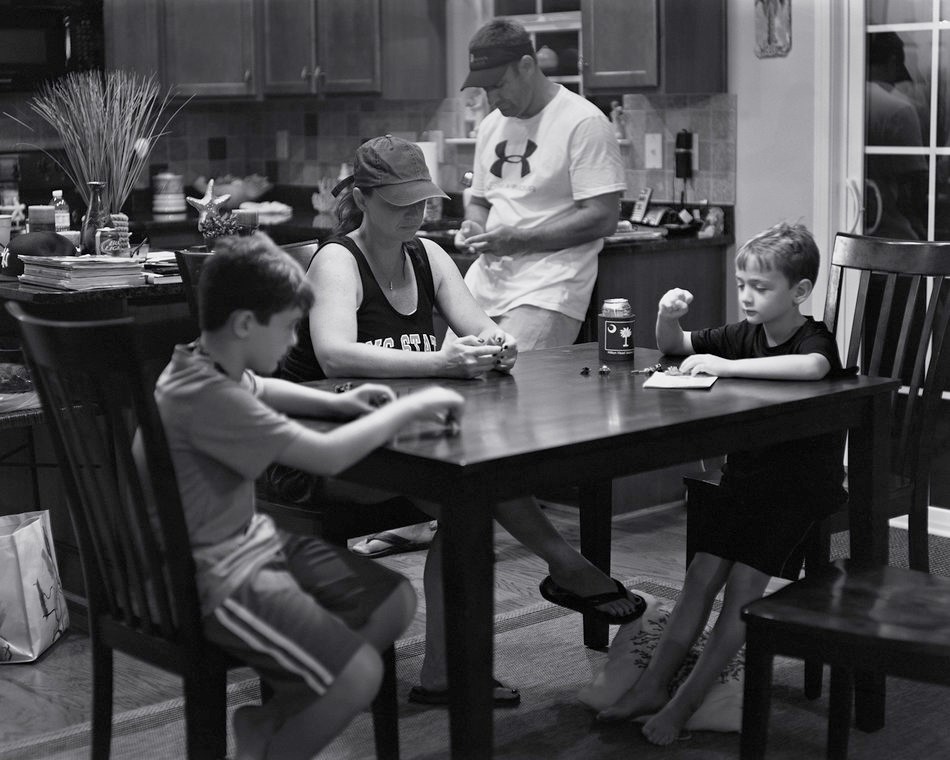
This is a new and disturbing mode of conscious awareness: intimate disconnection. This is the perspective of the photographer Eric Pickersgill, in a series of images he entitles Removed. We encounter representations of such disconnectedness every day.
In a minute or two I hope to finish writing this post then pick up my kids from school. Whilst waiting in the playground the phone will be with me. I couldn’t imagine it being anywhere other than in my back pocket. It will then see me through a perceived desultory moment or two prior to them emerging from their teacher’s class, by which time I might well be caught up, disconnected, a hostage to the war on my attention.
Mindfulness teaches me to recognize this. It gives me space to check in with the moment when my attention becomes caught up with perceived needs. In that space, there is a moment to choose. But many of us are now oblivious to this space of choice. Many of us are unaware of how our choice has been taken away.
We’re too caught up. Too content with our disconnection.
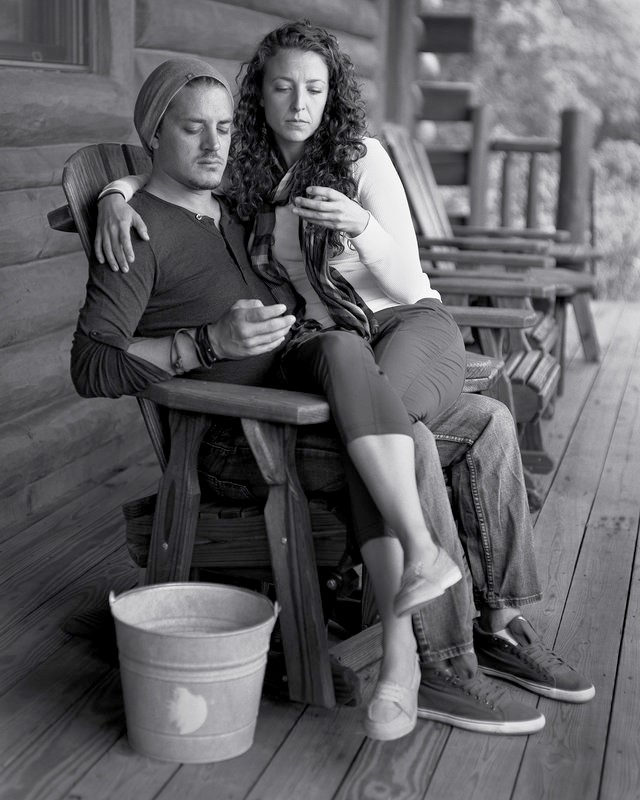
Is it possible that we’ve been distracted out of wanting our attention back, and that we love distraction more than we love the one we’re with?
practices for being in the here and now
Here are 16 mindfulness exercises to help you arrive in the here and now
* Stopping Still
Just stop still. What are you noticing? Are you hot, warm, or cold? Can you notice you are breathing?
* Weather Wonders
At different times of the day or year, when you are outdoors, stop and close your eyes or avert your gaze. What is the weather on your face? Sunshine, rain, wind, cold or warm? What is here now?
* What’s here?
Look around you and popcorn words for whatever you see in the room you are inside or the place you are outside.
* Belly and Chest Breathing
With one hand on your chest and the other on your belly, what movement can you find in these parts of the body, as you breathe?
Say to yourself: my body breathing this breath right now.
* Simply Be
Pause and move out of doing mode to just be. Noticing what’s here now. Can you just simply be? Sensing the connections of the body against the floor through the feet/legs and through the chair, if sitting down.
Bring curiosity and friendliness in the noticing of this experience of being here.
* Sounds
Listen to sounds. The sounds may be naturally occurring or chosen, such as the emergence of birdsong or traffic noise, or recording of sounds. Just listening to what is heard. Notice sounds as they arise. Notice the length of sounds: long sounds, short sounds. Notice sounds within sounds. Let yourself receive sounds. Notice where sounds land in the body. Notice thoughts triggered by sounds. Be curious about how sounds trigger your thoughts.
* Soles of the feet on the floor
Notice the sensations of your feet on the floor as you stand or sit. Maybe look at your feet or move them, perhaps rocking them side-to-side or back-to-front to help yourself tune into feeling them. Explore whatever sensations and name them.
* Sensing sound
Listen to specific sounds e.g. sirens, bells, waves breaking on a beach, the wind in the trees. Explore the texture of each sound. Move your fingers to sense the music/sound or draw or paint whilst listening to each sound, expressing what you are hearing and feeling.
* Whole Body Breathing
Lying down or sitting on a chair, seeing and feeling where the body moves as you breathe. Can you find any place in the body that doesn’t move, even a little bit, as you breathe? Just breathe normally and just watch and feel things as they are, right now.
* 5-4-3-2-1:
Tuning in to sensing five things we see, four we hear, three we touch, two we taste and one we can smell.
* Are you busy?
Are you busy switching between activities and moving at a fast pace? At a moment of your choosing, stop and observe, experience your busyness. Are you rushing? Are you focused on what you need to do? Noticing what is here now, inside and around you. Pause to feel your feet in this place before continuing what you are doing. What is that like?
** Heart-Focused Breathing.
Focus your attention in the area of the heart. Imagine your breath is flowing in and out of your heart or chest area, breathing a little slower and deeper than usual
Suggestion: inhale on five, exhale on five.
Now say to yourself, may I be kind to myself and kind to others. May I have compassion for myself and compassion for others. May I have confidence and joy in myself and be confident and joyful with others.
*** FOFBOC (Feet on Floor, Bum on Chair)
As you sit, begin by bringing your attention to the feet. Really tuning into the sensations of the feet as they touch the floor, noticing what that feels like, which parts of the soles of the feet are in contact with the floor and which are not, exploring and investigating these sensations with patient, kind curiosity.
Now including all the sensations of the feet, noticing what it’s like to be wearing socks and shoes.
Feeling now the weight and the texture of the legs, the lower halves, and the upper halves, really letting yourself explore what legs feel like from the inside.
Now, let your awareness expand up to include the sensations of sitting, tuning in to what it feels like to be in contact with the chair. What does sitting feel like from the inside? How is your weight distributed? Where exactly is the body actually touching the chair?
And now including in your awareness all the sensations in the lower half of the body… almost as if you’re anchored there -Feet on Floor, Bum on Chair-listening to the lower half of your body… receiving its textures as they change moment by moment.
Staying grounded in the lower part of the body.
Now, if you’re comfortable with it you might try including the sensations of breathing in your awareness. Without trying to change your breathing in any way, just notice what it actually feels like. You might notice the movement in the chest or the belly as you breathe in and out, whilst still being aware of the weight of your body in the chair, and the contact of your feet on the floor.
FOFBOC is Feet on Floor, Bum on Chair, but if you find it helpful you might bring your awareness to include the whole of the body as it quietly sits here, breathing. And then, when you’re ready, gently allowing your eyes to open.
*** 7/11
You start, as with a FOFBOC, feeling your feet on the ground…and then expanding to feel all the sensations of the lower half of the body. Then, in your head, count up to 7 as you breathe in, and then count up to 11 as you breathe out. Just breathe how you normally breathe. There is no need to change your breathing in any way.
Fit the numbers to the breath, rather than the other way around.
If you have to speed up the counting in order to get to 7 or to 11 by the end of the in-breath or out-breath, that’s fine.
What this exercise does is to take your focus away from the worry and to place it on the counting and the sensations of breathing.
It may also have the additional effect of lengthening both your in-breath and especially your out-breath. This can have the effect of slowing your heart-rate and taking you more in the direction of a sense of calm.
*** .B (dot-be)
Here is a signature practice from the Mindfulness in Schools Project. It’s called a .b (pronounced ‘dot-be’). It’s a portable practice you can drop into any time. It’s described as follows:
Doing a .b is a quick way to help your brain change mode – from being busy and thinking and doing to sensing/being. The basics of mindfulness are summed up in this practice. Shifting mode, or changing the gear of the mind is the “Core Skill” of mindfulness.
Doing a “.b” is the way to achieve this. It goes like this:
1. STOP whatever you are doing, maybe noticing you’ve been in auto-pilot or caught up in thoughts.
2. FEEL YOUR FEET on the ground. Let this ground/anchor you.
3. FEEL THE SENSATIONS OF BREATHING as it moves through your body.
4. Practise BEING – relaxing into the present moment, BEING HERE NOW.
**** Connect and Redirect: When your child is upset, connect first emotionally, right brain to right brain. Then, once your child is more in control and receptive, bring in the left brain lessons learned, or consequence.
***** Social Media meditation
Find a comfortable, alert, and ready posture. Shrug your shoulders, take a few breaths, and bring awareness to your physical and emotional state in this particular moment. Now open your computer or click on your phone. Before you open up your favorite social media site, consider your intentions and expectations. As you focus on the icon, notice what experiences you have in your mind and body. Why are you about to check this site? What are you hoping to see or not see? How are you going to respond to the different kinds of updates you encounter? By checking your social media, are you interested in connecting or in disconnecting and distracting? Close your eyes and focus on your emotional state for three breaths as you wait for the homepage or the app to open. Opening your eyes now, look at the first status update or photo, and then sit back and close your eyes again. Notice your response—your emotion. Is it excitement? Boredom? Jealousy? Regret? Fear? How do you experience this emotion in the mind and body? What’s the urge—to read on, to click a response, to share yourself, or something else? Wait for a breath or two for the sensations and emotions to fade, or focus on your breath, body, or surrounding sounds, perhaps with a mindful moment practice. Try this practice with one social media update, or for three or five minutes, depending on your time and your practice. Technology does not define us, despite social media trying to put us into categories and reduce us to a series of likes and interests. A Zen koan asks, “What did your face look like before you were born?” Today we might ask, “What did your Facebook page look like before you signed up?” It’s the deep question of who you really are, beyond a series of quantifiable interests and algorithms. Examining and changing our own relationship to technology opens the door for us to teach through example and to practice new ways of making technology spiritual. We can even consider ways to make spiritual technology for the young people who are growing up natives in the connected world.
***** Single Task:
With your eyes open or closed, place one finger gently in the center of your forehead. Just feel your finger against your forehead. And feel the sensations of your forehead against your finger. You might notice temperature, texture, moisture, even detect your pulse. Stay with this awareness a moment longer. If the mind wanders, just gently bring it back to the sensation of your finger on your forehead. Then open your eyes, take your hand down, and notice how you feel.
Books worth checking out:
Stephen Porges. The Pocket Guide to the Polyvagal Theory: The Transformative Power of Feeling Safe (Norton Series on Interpersonal Neurobiology) 1st Edition
Mark Williams and Danny Penman. Mindfulness: An Eight-Week Plan for Finding Peace in a Frantic World
Jan Chozen Bays. How to Train a Wild Wild Elephant & Other Adventures in Mindfulness
References for mindfulness exercises:
* ‘The Present’ curriculum. Copyright, 2018, Silverton, Dorjee and Sawyer
** ‘Transforming Stress for Teens’: the HeartMath solution for staying cool under pressure’
*** .B Curriculum, the Mindfulness in Schools Project.
little girl lost
Amy says, ‘Sir, I don’t think I’m going to pass.’
I notice anxiety in her posture and her eyes.
Seems like she’s the little girl lost.
I’m reminded of Oliver Sacks’ words: “People will make a life on their own terms, whether they are deaf or colorblind or autistic or whatever. And their world will be just as rich and interesting and full as our world.”
I tune into this, like a mantra: Amy, your world is just as rich and interesting and full as our world.
But does Amy know this? And can I help her to know, beyond simple platitudes?
I start by embracing a sense of not knowing. A sense of beginning again.
Beginning again is a safe, curious place from which to start.
The American spiritual teacher, Jack Kornfield, calls it the ‘middle way’; or “complete non-referential ease.”
Yes, I’ll try some of that.
Meanwhile, back in the present moment, Amy and I have a question to consider:
How is Lady Macbeth presented in this scene and the play as a whole?
I check in with her.
“How are you getting on?”
Amy says those words all too familiar to a teacher: “I don’t know what to write next”.
She elaborates: “I mean, I know what I want to say, but I don’t know how to write it. I can’t put it into words.”
What am I going to do? Shall I say:
“Let’s go through the keywords on the board.”
“Let’s think about your thesis statement.”
“Let’s consider Shakespeare’s intention.”
“Let’s pick out three quotes relevant to the themes you know “
I could do. However, reiteration of performance criteria is not going to help Amy in this moment. If anything, it’s going to make her more uncertain.
Amy needs a different set of criteria.
Amy needs safety.
I need it too. I feel Amy’s stuckness. I feel it as a heaviness in my head, a dullness in my chest. A sluggishness. It’s hard to articulate. And trying to do so will wither my will. And the last thing a teacher needs is a withered will.
Mindfulness is guiding me in this moment. It’s gently whispering to gently be with bodily sensations as they arise.
You know what? I’m lucky. Amy’s class is small. They’re a gentle, polite bunch of kids. The challenge is their – sometimes painful – reticence. I’ll ask a question and there will be this chasm – these tectonic plates of silence. It’s a different kind of challenge. The sound of silence. It can bring on lassitude, heaviness in the shoulders, weight to the eyelids.
But it’s also an opportunity for co-regulation. And co-regulation means bottom-up awareness. This means starting with the foundations of learning. The foundations of learning are the same as the foundations of a house. Would you build a house by putting in the windows first? The thought is laughable. But that’s what we do in the education system – at least in the system I know. We put in the windows. We prioritise the view of outcomes. We forget what it means to be a processing, feeling, experiencing human. Timetabling, content, even the building I am working in with its bright lights, hard desks and chairs, seem to be countered against the biological imperative known as co-regulation.
“Amy, how about you and I adjust our posture? Like this.”
I turn my chair so she can get a sidelong view of my sitting posture. Uprightness at the spine, shoulders dropping back, chin and crown of head level with the floor and ceiling. Tummy tucked in (hopefully).
Amy looks perplexed.
I ask, Why don’t you take a sip of water? Hey, let’s both take a sip of water, because, you know what? I’m feeling sluggish.The air is heavy in here.”
“OK“, Amy says, the wisp of a smile showing.
I continue: When I get stuck is I just say: OK, I’m stuck. It’s OK to be stuck. It’s pretty normal. Then I check in with how my body feels. I ask: where is it I’m feeling this stuckness? I’m kind of curious about that. How about you, Amy? I mean, are you stuck too?
In my head, she says. The side of my head.
She points to her right temple.
It’s pretty good that you can feel that.
What do you mean? Why’s it pretty good?
Well, it’s sort of making you aware that stuck-ness is not just a thinking thing. It’s happening in your body, and if you send this message to your body then your body might be able to help you get unstuck.
I’m not sure what you mean, Sir.
To be honest, I’m not sure about what I’m saying too. I find this mindfulness thing hard to articulate.
But here goes:
OK, well, I’m going to start by sitting upright because that’s immediately saying “bring it on” to my stuckness, it stimulates a change in attitude. I’m feeling a bit more assertive. It’s giving me more confidence in the body, regardless of what the mental challenge is. Then I’m going to take this biggish in-breath. Try it. It’s like a big, cooling, in-breath. Like the sip of water you just had, I suppose. It’s refreshing me. Then I’m going to feel a really long, soothing out-breath. I just want to clear my lungs of air. Clear my head. Now I’m going to count the in-breath up to the number five: so, one-two-three-four-five. Then hold it comfortably for a couple of seconds. Then with the longer outbreath I’ll count to seven: one-two-three-four-five-six-seven. Hold it comfortably again for a couple of seconds, then feel the inbreath again up to five. Shall we try that?
We spend about 30 seconds doing this, perhaps longer.
You see, I do this when I’m feeling a difficult emotion, stress, or a challenge because I find my energy starts to sap when I feel that way. Then I start to feel anxious, sometimes nervous…sometimes I just want to give up. Stop. I get frozen in the stuckness. Do you ever feel that?
Yes.
Then my mind starts telling me stories. It says: you’re no good at this. You never have been any good at this. And you think about the last piece of work you got stuck on because all you can remember is the last time you got stuck doing this. Then you say to yourself, “It’s me. I’m no good. I always feel like this when I have to do this type of question.” Then you start to get angry, frustrated, sad. Sometimes tearful. Then you think “I be I’m the only person who ever feels like this. And you look round the room and it always seems like everyone can do the work. They look so confident. Then you feel alone.
Somebody once said: there’s more right with you than wrong with you. Always. There’s always more right than wrong. That means there must always be more right with a situation than wrong with it. So that’s a good place to start. So perhaps just breathe in and out in this way and just say to yourself: there’s more right with this than wrong, and you’ll find that the quiet mind will allow ideas in. So let’s have some quiet time, just breathing this way.
And that’s what we do. We have about 2 minutes of quiet time.
Then I say:
You told me earlier in the lesson Lady Macbeth is like Macbeth. You said her tragedy comes from her excessive ambition. Did you say that?
Yes.
But now she feels guilty. And that guilt will lead to her suicide, right?
Yes
There’s so much that’s right with that; with you knowing that. So just take a moment to sit comfortably and breathe with that.
So what is Shakespeare’s intention here?
He wants to show us Lady Macbeth’s suicide
Is that what we see?
Yes.
Are you sure? I mean, where does it say in this extract that Lady Macbeth kills herself?
It doesn’t.
So what made you say that Shakespeare wants to show Lady Macbeth’s suicide?
Well, she kills herself later. That’s what I wanted to say.
So why does she kill herself later?
Because she feels guilty?
Why does she feel guilty?
Because she got Macbeth to kill Duncan. Because she’s got excessive ambition.
Why has she got excessive ambition?
Because of the witches.
Well, why didn’t she just ignore the witches? I mean, the witches are wrong aren’t they? I mean, the witches are morally wrong.
Yes, but she is already possessed by the witches. The letter she got from Macbeth. It made her possessed.
So that’s another scene from the play. That’s another scene you could connect with this one. So give me some of the keywords from the board to connect with what we’ve just talked about. What do you feel comfortable with? What do you feel safe about knowing? Just take a few moments to think about that. Perhaps just breathe slowly again. Because it seems to me that there’s more that you do know than you think you don’t know. There’s more right here than wrong. OK, so what are some of the keywords we want to work on?
Excessive ambition. Guilt. Possessed.
Any more?
Yes, supernatural. Great Chain of Being.
OK, that’s interesting. What else could you work on to get unstuck?
Stagecraft.
Yes. What about that?
Well, the audience can see her as guilty.
Really. How can they see her as guilty?
Well, it says: “will all the perfumes of Arabia not sweeten this little hand”.
So how does that show she feels guilty?
She wants to cover things up.
And that shows guilt?
Yes.
But how does it show guilt?
I don’t know.
So you’re stuck.
Yep.
Interesting.
I’m feeling a bit stuck too. So let’s just check in with the posture and breathing again. Take an inbreath and a slightly longer out-breath.
What’s my intention here? To create safety. Can I do this with the tone of my voice? Its modulation?
I’m aware of being tired now; of this questioning. It’s taking its autonomic toll.
I noticed that you zoomed in on the perfume as an image?
Well, before she says ‘perfumes’ she says the smell of blood.
Oh. OK. Well, what makes you say that?
Well, the blood is what Macbeth had on his hands after he killed Duncan. Macbeth felt guilty about that but Lady Macbeth told him to wash his hands.
What did she think washing his hands would do?
Make him feel less guilty, perhaps?
Why would washing your hands make you feel less guilty?
I don’t know.
OK. Let’s have a moment here.
Now it’s me who’s having the moment. I’m not sure if Amy is following but I do feel some synchronisation. It’s not intentional. It’s just arisen. And I need a moment for myself.
OK. Why would Lady Macbeth feel that washing your hands could make you feel less guilty?
Perhaps because she’s the fourth witch.
Really, how is she the fourth witch?
Amy smiles. Well…when she gets the letter…she becomes a witch because she says ‘unsex me here’ and fill me with cruelty’.
So has that got something to do with the guilt?
Yes, because witches don’t feel guilt.
So what you’re saying is that in the scene after Macbeth is feeling guilt after killing Duncan she doesn’t because she’s a witch?
Yes.
So why does she feel guilt now? Why does she feel that perfumes will not sweeten her hands?
Because she’s changed because Macbeth has taken over and he doesn’t care anymore even after he sees Banquo’s ghost, he’s not bothered and that shocks her. So perhaps now she can feel her own guilt now that she doesn’t have to make Macbeth feel guilty.
Here’s my reflection upon this teaching episode. This integration of the inner and outer curriculum:
Is this integrating co-regulation into pedagogy? Maybe. Amy is starting to give more extended responses because of this co-regulation where the teacher shares vulnerability with the student: it consists of neural exercise, modulation of voice, prosody, facial expression, gestures that are brought into the interaction: all mutual, synchronous, and reciprocal interactions between teacher and student. This awareness frames a new identity because the teacher knows the value of the frame as a part of the identity of being a teacher. It’s part of who we are together as co-learners. Student and teacher. It’s a shared autonomic state. It recognises the integration of teaching self-regulation as an experience that comes out of co-regulation. Both student and teacher learn together because the teacher acknowledges their own struggle with self-regulation. But see how long it has taken. See how much patience it requires. See how much dedication and commitment it requires – and not just to Amy, but to myself too. It’s compassion fostered through self-compassion.
Will measurable criteria culture recognise this? Will it make the necessary adaptations for the health, growth and restoration of Amy and myself? Of student and teacher? If so the results might be immeasurable.
What co-regulation fosters is this sense that it’s okay for both teacher and student to feel lost as they help each other to be found.
Stephen W. Porges, The Pocket Guide to the Polyvagal Theory: The Transformative Power of Feeling Safe (Norton, 2017),15,19,23,24. Deb Dana: The Polyvagal Theory in Therapy: Engaging the Rhythm of Regulation. (Norton, 2018), pg. 4
approaching mindfulness

A few summers ago a sunflower emerged in front of two weary, dilapidated sheds. It had pushed itself out between a crack of paving slab, and some scabrous weed. I became curious about its supple, subtle, resilient growth. I delighted in its presence. Its proud, virulent spear of mantis green. It became the focal point of the garden.
During my son’s 3rd birthday party the children, unbidden, gravitated to its ring-around presence.

It also came in handy for charting other significant milestones of growth.
It became part of the fabric of everyday life.
I was beginning to find that by simply documenting its slow growth, as it harbored in warm shades of summer light, it became an anchor for my own emerging – albeit inchoate – sense of mindfulness. It embodied stillness and rooted patience. It gave me some sense of what is meant by the unfolding of present moments.
Then I noticed a botanic sidekick emerging just outside the sunflower’s protective shadow. A small bedding plant, in full bloom.
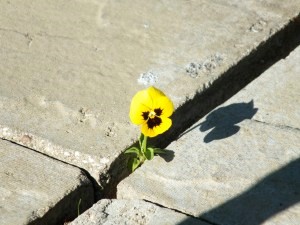
This new presence somehow guided me to a sense of myself as a child. To a sense of how vulnerable I was.
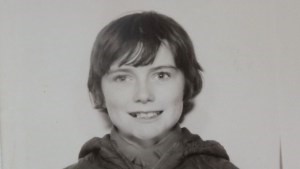
Both sunflower and the bedding plant were coming to represent the idea of how we are seeds sown – scattered haphazardly – between cracks and scabrous weed, until, that is, we emerge into our own particular light.
I thought about how I too needed to be protected as a child, but also of how my parents had experienced their own vulnerability; how they had come from not the most auspicious of starts in life – not unlike the sunflower and the bedding plant. I thought of how we are all – in our present moments – a younger self; a still innocent self attempting to grow under the stern sun between the harsh spaces and the sometimes welcome – sometimes not so welcome – shades; of how we are still connected to the self that seeks and seeks to be sought. Seeks to be nurtured. Seeks to be seen. To be valued. To be loved.
Lord, how we need to be loved.
Perhaps it is only through the prolonged noticing of things that we sow seeds of compassion towards ourselves before knowing how to extend it out towards others. Perhaps you are still that child. Perhaps you are still in the process of becoming. Perhaps in that process, you learn – oftentimes painfully – how to let go.
The sunflower and its sidekick did their best, regardless of the inauspicious start; regardless of their place in the prescribed order of things. The place where they grew had no effect on the vitality of their existence. All they needed was to be offered the active hope of being themselves.
And so, through the rains of summer,

and the hints of early autumn’s ‘mellow fruitfulness’,

the sunflower started to bloom.

Craning its neck toward the westward sun.
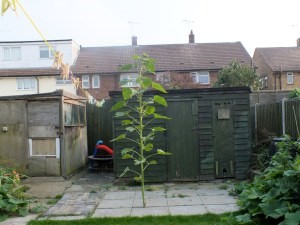
Slowly awakening…awakening slowly, out of its seemingly unwelcome home.
Until the storm came.
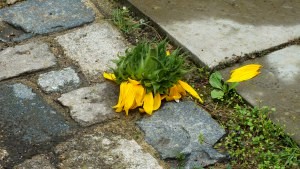
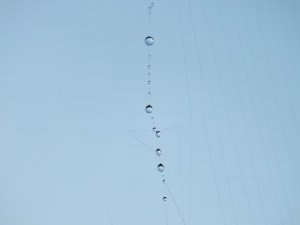
And my attention was diverted to other images of impermanence.

There was a sunflower.
Then there was no sunflower.
Between existence and non-existence, there is a place of exploration that offers itself in a series of unfurling present moments that are each a new beginning.
What we call the beginning is often the end
And to make an end is to make a beginning….
We shall not cease from exploration
And the end of all our exploring
Will be to arrive where we started
And know the place for the first time.
TS Eliot – Little Gidding